

Making Decisions in Uncertain Times: 4 Questions for Leaders and Organizations that Grow Exponentially
In a world defined by volatility, uncertainty, complexity, and ambiguity, inaction can cost more than making a mistake.

In an era of constant disruption, waiting for perfect conditions to make decisions is a costly mistake. This article adapts and expands on the ideas of Cheryl Strauss Einhorn (2025) and connects them with three high-impact methodologies: Exponential Organizations (ExO), the Adizes model, and Scaling Up. It also incorporates the Cynefin framework to diagnose decision contexts and choose the most effective strategy. The goal: to offer four key questions for acting with clarity and purpose, strengthening adaptability, conscious leadership, and strategic execution.
Introduction
In a world defined by volatility, uncertainty, complexity, and ambiguity, inaction can cost more than making a mistake. Exponential Organizations (ExO) thrive because they don’t wait for the environment to stabilize; they learn and adapt in real time (Ismail, Malone & van Geest, 2014). The Adizes model reminds us that in every stage of the organizational lifecycle, there are critical decisions that determine whether a company matures or declines (Adizes, 2004). Scaling Up teaches that agile execution, focus, and disciplined priorities are essential for sustained growth (Harnish, 2014).
When I read the article In Uncertain Times, Ask These Questions Before You Make a Decision (Einhorn, 2025), I immediately connected these four questions to strategic decision-making in rapidly changing environments. Today, we adapt them to a framework that unites purpose (ExO), lifecycle (Adizes), and strategic priorities (Scaling Up).
- ExO thrives by acting, learning, and adapting in real time (Ismail et al., 2014).
- Adizes reminds us that each lifecycle stage requires decisions that avoid bureaucracy or stagnation.
- Scaling Up teaches that agile execution and disciplined priorities are key to sustained growth (Harnish, 2014).
Question 1: What decision today will still make sense a year from now?
In high-pressure environments, it’s easy to prioritize the urgent over the important. Exponential Organizations (ExO) operating with a Massive Transformative Purpose (MTP) use this question to filter initiatives that align with long-term impact. In Scaling Up, it connects with the 3–10 year vision and the One Page Strategic Plan (OPSP).
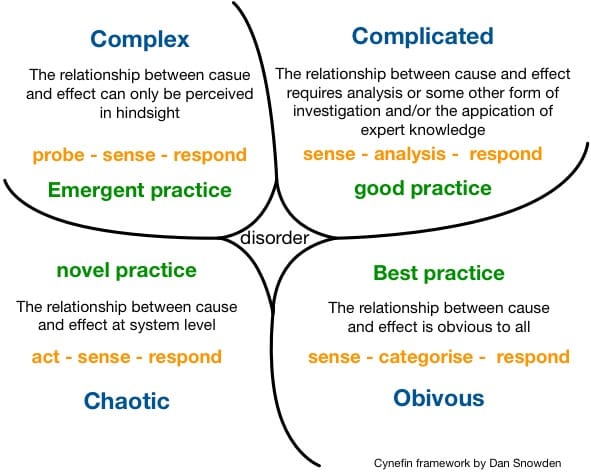
Here’s where the Cynefin framework (Snowden & Boone, 2007) comes in:
- Clear: the answer is evident, and the one-year projection is reliable.
- Complicated: requires expert analysis but can be planned for the future.
- Complex: decisions are made through experimentation and iterative learning.
- Chaotic: act quickly to stabilize while ensuring the action leaves long-term value.
Example:
A SaaS company receives a proposal to develop a module outside its roadmap, but with immediate profitability. Using Cynefin, it determines it’s in a complex context and decides to prioritize investments that strengthen its competitive advantage and scalability over the next 12 months.
Question 2: If this decision became an example of your leadership, what would it teach?
Every decision sends a message about the organization’s culture and values. For an ExO, where culture is a multiplier of speed and trust, this question is critical to assess whether an action reinforces or erodes integrity and cultural coherence. In Adizes, the Integrator (I) role preserves trust and cohesion. In ExO, culture accelerates impact; in Scaling Up, it’s the foundation for attracting and retaining top talent.
Example:
A director is pressured to report more optimistic sales numbers. Asking what the decision would teach leads to choosing transparency, strengthening credibility, even if the immediate impact is negative.
Question 3: What if this isn’t the storm, but the climate?
Many companies react to disruption as if it were temporary. ExOs assume constant change is structural and adapt their business models accordingly. In ExO, this activates Scalability and Adaptability. Adizes warns that failing to adapt to the “new climate” leads to bureaucracy. Scaling Up recommends adjusting quarterly priorities.
Here, Cynefin helps distinguish:
- If the change is complex or chaotic, it is probably structural.
- This requires redesigning processes, products, and business models to adapt.
Example:
An industrial company discovers that 70% of its clients prefer digital interaction. Upon analysis, they see the pattern is persistent and cross-sectoral. They adjust their sales model toward digital self-service and virtual experiences as part of their “new climate.”
Question 4: What’s the cost of waiting?
Inaction has a price. In fast-moving markets, every day of delay is a lost opportunity. This question reframes strategic discussions from passive prudence to agile action. In Scaling Up, waiting means losing momentum. In ExO, it’s missing out on being an early mover. In Adizes, during the Go-Go stage, it can prevent consolidation.
Example:
A competitor launches a sustainable product. The company has a similar prototype, but the committee wants to wait. Calculating the cost in market share and positioning motivates an immediate pilot launch.
Embedding in the Organizational DNA
These questions can be institutionalized in the organization’s decision-making process, incorporated into frameworks like CAPI (Coalescing Authority, Power, and Influence) or into Experimentation and Scalability routines. This way:
- Decisions are aligned with the MTP and long-term impact.
- Culture and exemplary leadership are reinforced.
- Structures and processes adapt to the new context.
- Paralysis is reduced, and strategic speed increases.
Conclusion
Uncertainty isn’t resolved by waiting; it’s clarified through action. Integrated with ExO, Adizes, and Scaling Up, these questions help make decisions with purpose, adaptability, and strategic discipline.
How does your organization make decisions when the future is unclear? Which of these questions would most transform your team today? Share your experiences to help build more adaptable, conscious, and strategic organizations.
References
- Adizes, I. (2004). Managing Corporate Lifecycles. The Adizes Institute.
- Einhorn, C. S. (2025, May 1). In uncertain times, ask these questions before you make a decision. Harvard Business Review. https://hbr.org
- Harnish, V. (2014). Scaling Up: How a Few Companies Make It…and Why the Rest Don’t. Gazelles Inc.
- Ismail, S., Malone, M. S., & van Geest, Y. (2014). Exponential Organizations: Why New Organizations Are Ten Times Better, Faster, and Cheaper Than Yours (and What to Do About It). Diversion Books.
- Snowden, D. J., & Boone, M. E. (2007). A Leader’s Framework for Decision Making. Harvard Business Review.

ExO Insight Newsletter
Join the newsletter to receive the latest updates in your inbox.