

Game Theory for Exponential Leaders: How Nash Helps Build Sustainable Ecosystems
Every organization is playing multiple simultaneous games — with customers, suppliers, regulators, competitors, and even its own team. In these games, success doesn’t come from winning every round, but from finding equilibria where all players have enough incentive to keep playing.

The Silent Game We’re All Playing
Every organization is playing multiple simultaneous games — with customers, suppliers, regulators, competitors, and even its own team. In these games, success doesn’t come from winning every round, but from finding equilibria where all players have enough incentive to keep playing.
John Nash proved that such equilibria exist — and that rational cooperation, not domination, produces long-term stability.
In exponential ecosystems, this insight becomes vital: when growth is fueled by networks, platforms, and partnerships, your survival depends on the stability of shared incentives.
From Nash to ExO: Why Incentives Are the New Code
In every organization, people play roles that mirror Nash’s players in a strategic game. Dr. Ichak Adizes identified four essential roles that must coexist in balance for any system to thrive:
- P – Producer: Delivers results and execution.
- A – Administrator: Ensures structure, consistency, and control.
- E – Entrepreneur: Drives innovation, experimentation, and vision.
- I – Integrator: Builds trust, collaboration, and long-term cohesion.
When one of these roles dominates — for example, too much “P” without “I” — the system becomes unbalanced, much like a non-cooperative game where each player optimizes only for themselves. But when the four roles interact constructively, they form a collaborative equilibrium, where decisions maximize both performance and continuity.
In traditional business, competition is often viewed as a zero-sum game: I win, you lose. In an Exponential Organization (ExO), the logic flips: I scale faster when you do too. This shift from rivalry to co-evolution is precisely what Nash envisioned — a system where rational cooperation becomes the optimal strategy
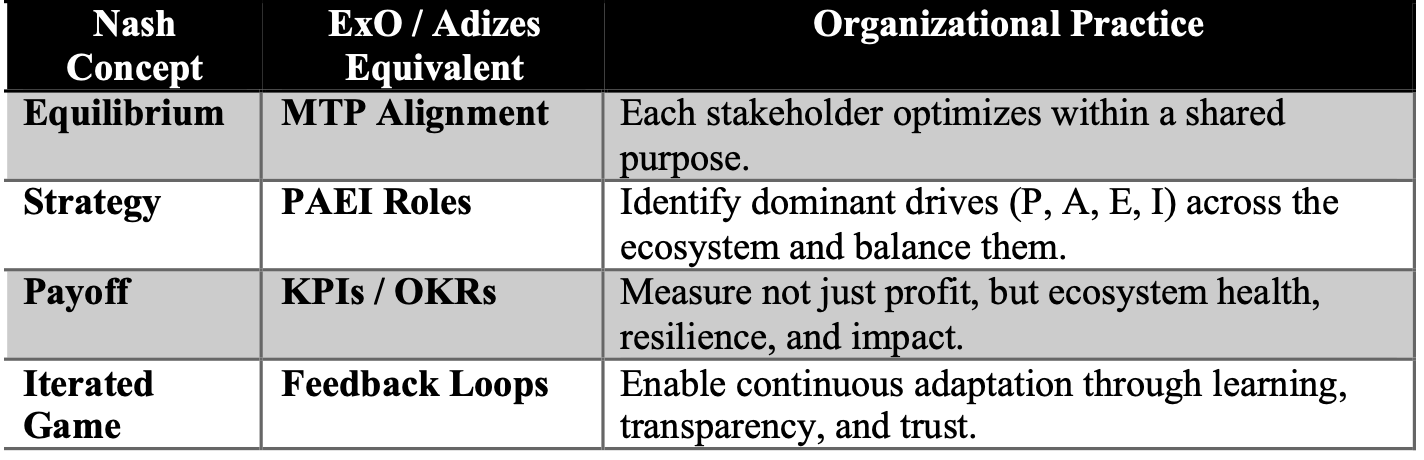
When incentives are transparent and shared, equilibrium evolves from competition to collaboration by design. That is the mathematical foundation of trust inside an Exponential Organization.
Case in Point: Strategic Equilibrium in Dynamic Ecosystems
Consider a modern ecosystem — whether it’s a tech startup, a renewable energy consortium, or a healthcare network. Each player acts with partial information, limited resources, and their own incentives — yet all are deeply interdependent.
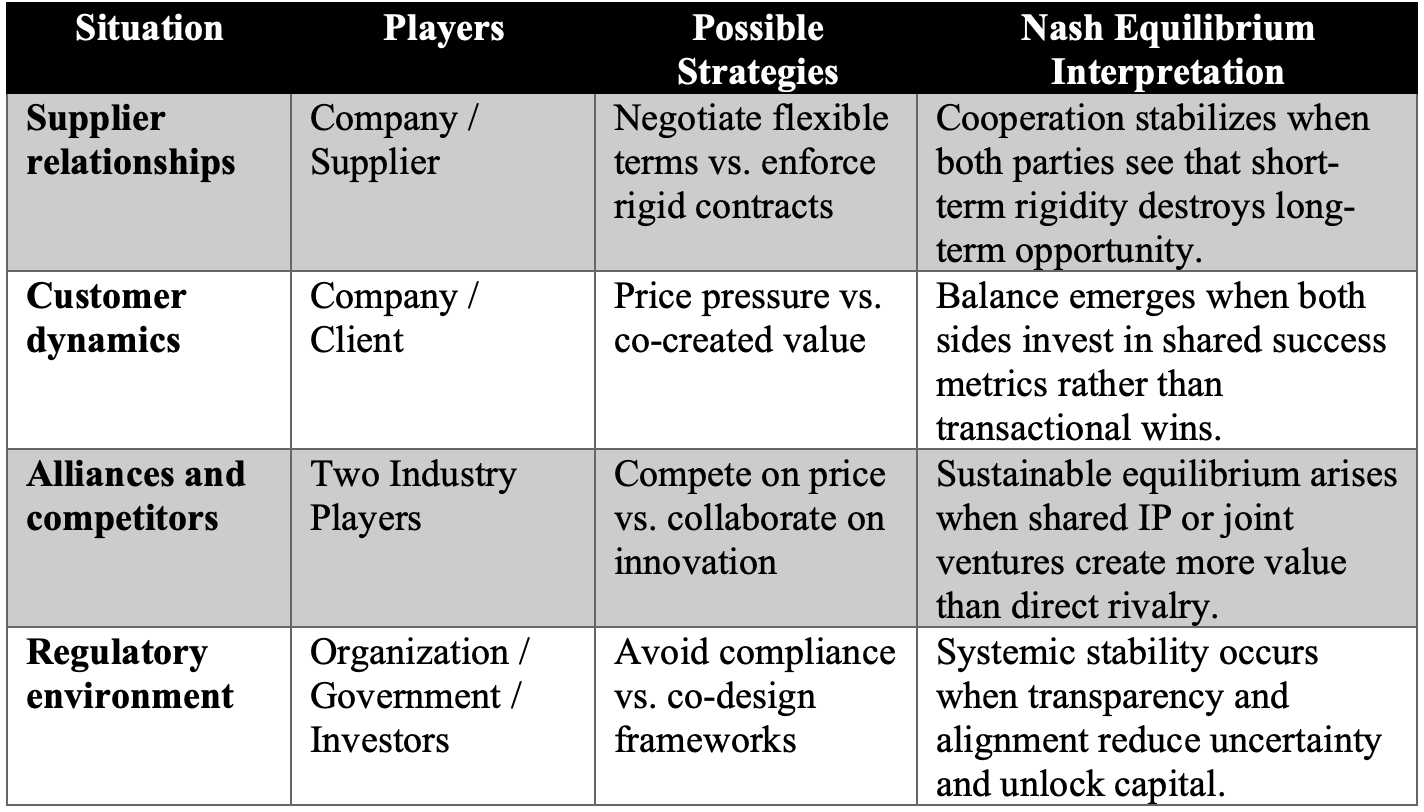
Each of these examples reveals a shift from technical optimization to systemic balance, where trust and strategic transparency generate mutual resilience. In exponential ecosystems, equilibrium is not a static endpoint but a moving target, continuously redefined by data, feedback, and evolving incentives.
The Ecosystem Equilibrium Map
The Ecosystem Equilibrium Map is a visual model that helps Exponential Leaders map the dynamics of cooperation, transparency, and adaptability across their networks.
Axes
- X-axis: Level of Cooperation (Competitive → Collaborative)
- Y-axis: Degree of Transparency and Shared Incentives
- Z-axis: Learning Speed / Feedback Velocity
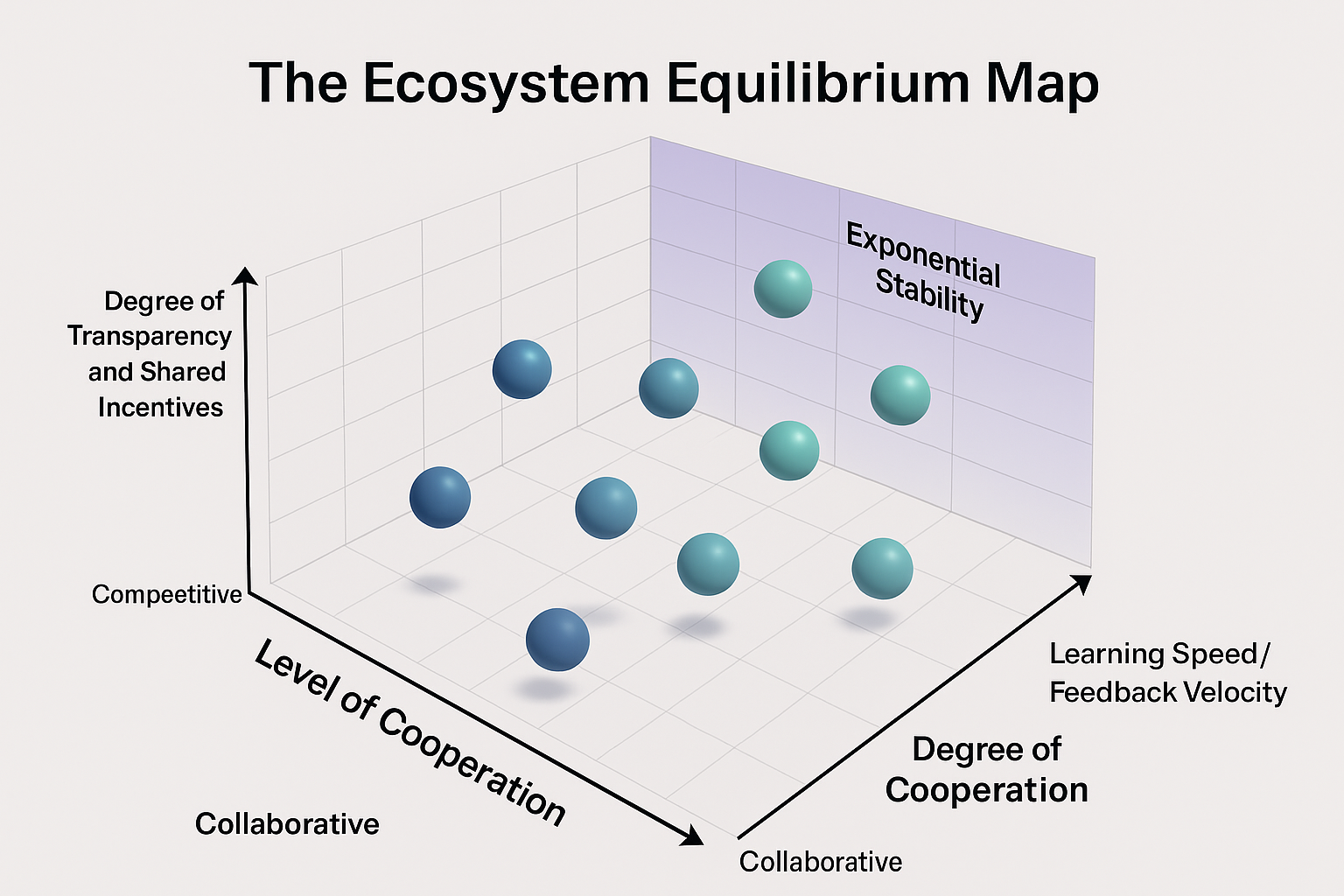
Each actor (organization, partner, regulator, or community) is represented as a node in this 3D field. Their position reflects how aligned and responsive they are within the ecosystem. When cooperation and transparency increase, nodes move upward and right, approaching the zone of Exponential Stability — where collaboration is self-reinforcing.
In practice, leaders can plot their stakeholders on this map — suppliers, clients, regulators, investors — to visualize where equilibrium is strong or fragile, and where incentives must evolve to sustain exponential growth.
“Equilibrium is not a destination — it’s a living orbit of trust.” — Mike Sainz
How Exponential Organizations Can Play the “Infinite Game”
In volatile, uncertain, complex, and ambiguous (VUCA) environments, static equilibriums collapse fast. ExOs must learn to build adaptive systems that evolve continuously — fueled by feedback, iteration, and reputation.
Practical frameworks for leaders:
- Map simultaneous games. Sales, finance, operations, and innovation are all interdependent systems.
- Define incentive matrices. Ask, “What does each player gain or lose if I change my move?”
- Model scenarios. Use data visualization tools to simulate payoffs and cooperation thresholds.
- Design for repeat play. Move from one-shot transactions to recurring, trust-based cycles.
When the system rewards integrity, transparency, and shared value creation, cooperation becomes the rational choice.
The Adizes Lens: Turning Conflict into Constructive Tension
Adizes teaches that every organization is a living system composed of interdependent roles — Producer, Administrator, Entrepreneur, and Integrator (PAEI). Each represents a different logic of value creation: execution, control, innovation, and connection.
When one role dominates, the organization behaves like a non-cooperative game: each function maximizes its own outcome, creating internal friction and energy leaks. But when these roles align through CAPI (Coalesced Authority, Power, and Influence), tension becomes productive energy — transforming conflict into coordination.
This integration produces a Nash-like equilibrium inside the company, where the forces of innovation, discipline, and trust reinforce each other. That’s how internal alignment becomes the foundation for external scalability.
From Competitive Advantage to Cooperative Equilibrium
Nash’s lesson isn’t about altruism; it’s about sustainable self-interest.
Exponential leaders don’t “win” by defeating others; they win by creating systems where no one wants to defect — because the ecosystem itself delivers more value than any isolated actor could achieve.
“The goal is not to win the game, but to keep the game worth playing.” — Inspired by James P. Carse, Finite and Infinite Games (1986)
That’s the hidden mathematics behind exponential success.
Takeaway for Exponential Leaders
- Replace control with incentive alignment.
- Design feedback loops where data reinforces trust.
- Use conflict as a diagnostic for system imbalance.
- Build ecosystems where equilibrium = scalability.
In the age of networks, your strategy is only as stable as the incentives of your partners. Nash showed it mathematically. ExOs are proving it exponentially.
References
- Adizes, I. (2004). Managing Corporate Lifecycles: How Organizations Grow, Age and Die. Santa Barbara, CA: Adizes Institute Publications.
- Carse, J. P. (1986). Finite and Infinite Games: A Vision of Life as Play and Possibility. New York, NY: Free Press.
- Harnish, V. (2014). Scaling Up: How a Few Companies Make It... and Why the Rest Don’t. Gazelles Inc.
- Ismail, S., Malone, M. S., & van Geest, Y. (2014). Exponential Organizations: Why New Organizations Are Ten Times Better, Faster, and Cheaper Than Yours (and What to Do About It). New York, NY: Diversion Books.
- Ismail, S., Diamandis, P. H., & Sainz, M. (2023). Exponential Organizations 2.0: The New Playbook for 10x Growth and Impact. OpenExO Media.
- Nash, J. F. (1950). Equilibrium Points in N-Person Games. Proceedings of the National Academy of Sciences, 36(1), 48–49. https://doi.org/10.1073/pnas.36.1.48
- Sinek, S. (2019). The Infinite Game. New York, NY: Portfolio / Penguin Random House.
- Vuca World. (n.d.). VUCA: Volatility, Uncertainty, Complexity and Ambiguity. U.S. Army War College, Strategic Leadership Primer.
This article was originally published on MikeSainz.com, as part of Mike Sainz’s series on exponential leadership and organizational ecosystems.

ExO Insight Newsletter
Join the newsletter to receive the latest updates in your inbox.