
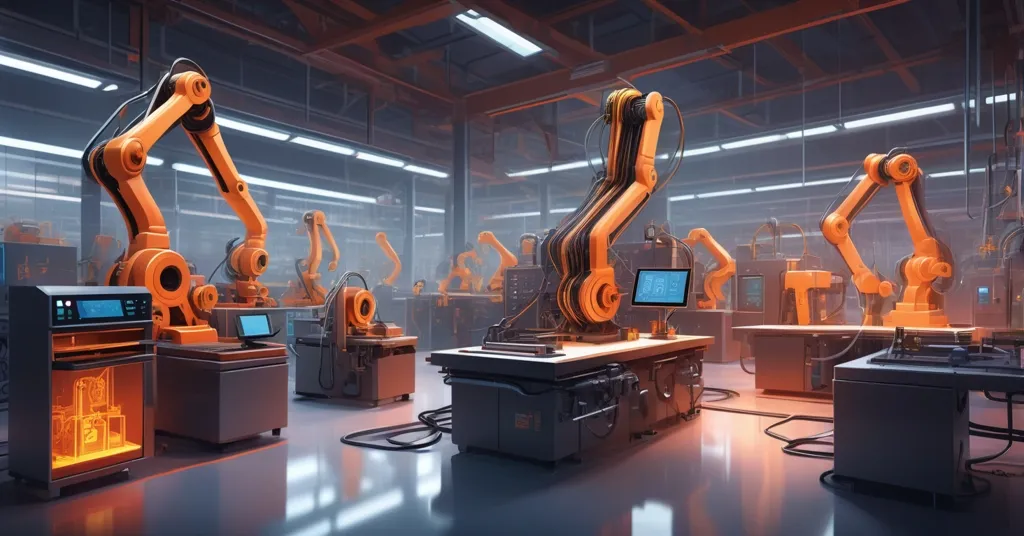
The Hidden Profit Center: 3D-Printed Tooling in Brownfield Plants for Industry 4.0 Success
Discover how 3D-printed tooling is revolutionizing brownfield plants, slashing downtime by over 90% and transforming costs into profit drivers. This powerful shift is redefining agility and fueling Industry 4.0 growth—dive in to unlock the potential for your operations!
A manufacturing plant screeches to a halt, bleeding thousands of dollars per hour because of a single broken tool. Then, with a shift to 3D-printed tooling in manufacturing, that same facility slashes downtime by over 90%, transforms a cost burden into a profit driver, and redefines operational agility. This is the reality unfolding in brownfield plants across sectors, where additive manufacturing is unlocking hidden value and propelling organizations toward exponential growth. For business leaders, consultants, and C-suite executives, tapping into this technology isn’t just a competitive edge—it’s the key to thriving in the fast-paced landscape of Industry 4.0.
The Costly Challenge of Brownfield Plants
Brownfield plants—existing facilities often weighed down by outdated infrastructure—face relentless pressure to boost efficiency while keeping costs in check. Traditional tooling methods are slow, expensive, and rigid, often leading to production delays that sting. Downtime alone costs between $15,000 and $25,000 per hour across industrial sectors, a staggering loss that can cripple profitability. The need for rapid, cost-effective solutions has never been more urgent as global markets demand speed and adaptability.
Legacy systems exacerbate these challenges, locking manufacturers into long lead times for tools and fixtures. Replacement parts or custom jigs can take weeks to source, grinding operations to a halt. Beyond financial losses, these inefficiencies erode customer trust and market position. Yet, amidst these constraints, a transformative opportunity emerges through additive manufacturing, ready to turn operational headaches into strategic wins with solutions tailored for brownfield factory upgrades.
3D-Printed Tooling: A Profit Powerhouse
Additive manufacturing, or 3D printing, offers a revolutionary approach to tooling, jigs, and fixtures, slashing costs by 70-90% and delivering payback periods of under 12 months. Some forward-thinking companies even report returns on investment exceeding 300% annually. This isn’t just about trimming expenses; it’s about creating a hidden profit center that fuels exponential growth in manufacturing.
The data backs this up with striking clarity. Organizations adopting 3D-printed tooling achieve average cost savings of 78%, with payback timelines as short as 4.7 months. This technology empowers plants to produce tools on-site, cutting reliance on external suppliers and accelerating response times. What if your facility could save millions by printing critical parts in-house? For many, that shift is already turning struggling operations into profit machines.
“3D-printed manufacturing aids represent a transformative opportunity for brownfield plants to unlock hidden profitability through dramatic reductions in downtime, changeover times, and tooling costs.”
Success Stories Across Industries
Real-world examples illustrate the tangible impact of this technology across diverse sectors. MAHLE, an automotive supplier, reduced fixture costs by 90%—from $8,000 to just $800—and cut production time by 85%, shrinking timelines from 4-5 weeks to under a week. Ford redesigned a Mustang quarter glass alignment fixture, achieving an 83% cost reduction and 70% faster production. These results aren’t outliers; they’re proof of a replicable model detailed in automotive manufacturing case studies.
Volkswagen Motorsport leveraged 3D printing for wind tunnel models on the I.D. R Pikes Peak racing car, slashing costs by 68% and compressing development from weeks to days. In aerospace, Leonardo implemented 3D-printed rotor cradles for the Royal Navy helicopter program, speeding up production fourfold with a payback period of just six months. Even smaller players like Red Oak Fabrication saw welding jig costs drop by 90%—from $1,000 to $100 per jig—using advanced materials, with jigs enduring over 1,000 uses monthly.
Unilever, in the consumer goods space, cut prototype lead times by 40% and saved 60% on development tooling. These stories underscore a critical point: from automotive giants to niche fabricators, additive manufacturing delivers measurable gains in cost, speed, and operational efficiency, positioning companies for market leadership as seen in various Industry 4.0 success stories.
Innovative Materials and Technologies
The magic behind 3D-printed tooling lies in cutting-edge materials and processes that rival traditional options. Take Carbon Fiber Reinforced Nylon (CF-Nylon), a material so strong it can replace aluminum fixtures in high-stress environments, with the toughness to resist breaking under pressure. It withstands heat up to 184°C, making it ideal for harsh factory conditions. Other options like PEEK handle extreme heat—up to 260°C—perfect for demanding applications, while ULTEM offers similar durability at a more accessible price point, as explored in expert reviews of high-performance materials.
The technologies driving these materials are just as impressive. Stereolithography (SLA) delivers pinpoint accuracy, ensuring tools fit perfectly with margins as tight as ±0.1mm. Fused Filament Fabrication (FFF) stands out for its versatility, allowing a wide range of materials to be used affordably. Multi Jet Fusion (MJF) shines in producing batches of parts quickly, much like a high-speed assembly line. Together, these advancements enable manufacturers to customize solutions, iterate rapidly, and meet market demands with unmatched flexibility.
Digital Inventory: The Virtual Warehouse
One of the most powerful aspects of additive manufacturing is the shift to digital inventory strategies. Traditional physical inventory ties up capital, with holding costs ranging from 20-55% of a part’s value annually. Digital inventories eliminate this burden through on-demand production, allowing companies to store designs virtually and print tools only when needed. This can shrink downtime from 14 days to just 1 day, saving between $2.5 and $4.2 million per incident, as highlighted in recent advancements in digital inventory.
BMF GmbH, for instance, used digital inventory to drastically reduce customer downtime, ensuring parts are printed locally and swiftly. This virtual warehouse model aligns seamlessly with the principles of exponential organizations, emphasizing scalability and responsiveness. By reducing overhead and boosting agility, digital inventory doesn’t just cut costs—it redefines how brownfield plants operate in a competitive landscape.
Strategic Alignment with Exponential Organizations
Beyond immediate gains, 3D-printed tooling embodies the core attributes of Exponential Organizations (ExOs) as outlined in Exponential Organizations 2.0. It leverages on-demand production to scale rapidly, slashing the constraints of traditional supply chains. It also taps into external resources, such as shared printing hubs, to minimize capital expenditure while maximizing output. This approach fosters an abundance mindset, where innovation drives not just incremental improvements but 10x growth potential.
For business leaders, this technology positions manufacturing as a platform for transformation. It enables rapid experimentation, allowing firms to test new designs without the financial risks of conventional tooling. By embedding these principles, companies can pivot from reactive operations to proactive, future-ready strategies, securing a foothold in the next wave of industrial evolution, especially within the context of Industry 4.0 and smart manufacturing.
Overcoming Adoption Challenges
Adopting 3D printing in brownfield plants comes with hurdles, but they’re opportunities to innovate. Initial investments for industrial-grade systems start around $65,000, with annual operating costs near $142,500. Yet, projected savings of $200,000 to $400,000 often offset these within months. Beyond finances, quality assurance is critical to meet industry standards—solutions like real-time monitoring from providers such as ADDere help maintain consistency and compliance.
Intellectual property protection is another concern in a digital-first approach. Encrypted file transfers and secure workflows, as championed by platforms like AMFG, safeguard designs from theft or misuse. Organizational change management also demands attention; workforce training and cultural shifts are vital. A practical start is launching pilot programs to demonstrate value, paired with upskilling initiatives—think of it as equipping your team with the tools to build tomorrow’s factory today, a topic of interest in communities like online discussions on 3D-printed tools.
Environmental considerations add another layer. While 3D printing reduces material waste compared to traditional methods, energy consumption for industrial printers and the use of non-recyclable polymers pose challenges. Adopting sustainable materials and energy-efficient systems can mitigate these impacts, aligning with broader corporate responsibility goals. Meanwhile, cybersecurity risks in digital inventories—such as data breaches—require robust encryption and access controls to ensure operational integrity.
“The data overwhelmingly supports 3D-printed tooling as not just a cost-reduction opportunity, but a strategic enabler of manufacturing excellence in an increasingly competitive global marketplace.”
Critical Insights and Questions
- How can brownfield plants overcome initial resistance to adopting 3D printing technologies, especially in terms of workforce training and cultural shifts?Begin with small-scale pilot projects in high-impact areas like downtime reduction to showcase tangible benefits. Pair this with targeted training programs to build skills and confidence, while leadership champions a culture of innovation to ease the transition.
- What are the long-term environmental impacts of scaling 3D-printed tooling, particularly regarding material waste and energy consumption?Although additive manufacturing cuts waste compared to subtractive methods, the energy demands of industrial printers and non-recyclable materials remain concerns. Prioritizing renewable energy sources and recyclable polymers can help balance efficiency with sustainability.
- How can smaller manufacturing firms with limited budgets access the benefits of additive manufacturing without high initial costs?Shared 3D printing hubs or leasing models provide affordable entry points. These options allow smaller firms to test the technology and scale gradually without the burden of large upfront investments.
- What role do regulatory bodies play in standardizing quality assurance for 3D-printed tooling across different industries?Regulatory bodies are developing standards for material properties and production processes, ensuring safety and reliability, especially in critical sectors like aerospace and automotive. Staying aligned with these guidelines builds trust and consistency.
- How might advancements in 3D printing materials expand applications in extreme environments or niche sectors?Emerging composites and high-performance polymers could enable tools to withstand harsher conditions or serve specialized fields like robotics and orthotics, opening new markets and opportunities for innovation.
Final Thoughts and Key Takeaways
The path to exponential growth through 3D-printed tooling blends tactical wins with visionary strategy. Harnessing advanced materials like CF-Nylon, leveraging technologies like FFF and MJF, and embracing digital inventory can eliminate inefficiencies and unlock hidden value. More than that, aligning with the abundance mindset of Exponential Organizations 2.0 positions your organization for transformative, not just incremental, progress. Start by identifying a high-impact area—perhaps downtime reduction or rapid prototyping—and build a roadmap for broader integration.
Here are essential takeaways to guide your journey:
- 3D-printed tooling can reduce costs by up to 90% with ROI often under 12 months.
- Digital inventory cuts traditional holding costs, boosting responsiveness.
- Materials like CF-Nylon and technologies like SLA provide durable, practical solutions.
- Success stories from Ford, MAHLE, and Volkswagen prove applicability across industries.
- Strategic adoption requires addressing quality, IP protection, and organizational readiness.
Take a bold step now by evaluating where additive manufacturing can drive value in your operations. Whether you’re steering a global enterprise or innovating in a mid-sized firm, the moment to act is here. Build on these insights to fuel transformative growth and secure a leading edge in the era of Industry 4.0.

ExO Insight Newsletter
Join the newsletter to receive the latest updates in your inbox.