
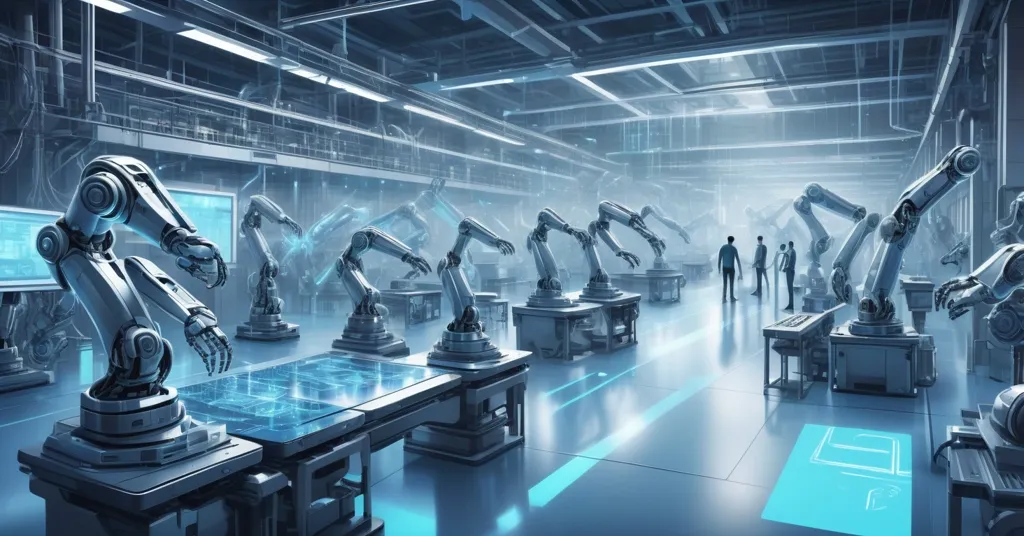
Siemens Transforms Manufacturing with AI Copilots for Exponential Growth
Siemens AG, a 175-year-old industrial titan, is revolutionizing manufacturing with AI copilots, achieving 60% faster code development and 50% productivity boosts.
Siemens AG, a German industrial giant with over 175 years of history, is shattering the notion that legacy firms can’t achieve explosive growth. By harnessing AI copilots and embracing Exponential Organization (ExO) principles, Siemens is not just keeping pace with the Fourth Industrial Revolution—it’s leading the charge in digital transformation for manufacturing. With staggering gains like 60% faster code development and productivity boosts of up to 50%, their story offers a powerful roadmap for any organization aiming to unlock 10x growth through exponential technologies.
The manufacturing sector faces relentless pressures: skills shortages, sustainability demands, and the urgent need for faster innovation cycles. Siemens has turned these challenges into opportunities, leveraging AI-driven solutions and strategic partnerships to redefine industrial automation. Their journey showcases how even the most established firms can pivot to a mindset of abundance and scale, proving that exponential growth isn’t reserved for tech startups. Let’s dive into how Siemens is rewriting the rules of the game.
Embracing ExO Principles for Exponential Growth
At the core of Siemens’ transformation lies a commitment to Exponential Organization (ExO) methodologies, a framework designed to drive massive growth through innovative strategies. Key ExO attributes like Staff on Demand (flexibly hiring top talent as needed), Algorithms (using data-driven automation), and Interfaces (streamlining human-machine interaction) are evident in their approach. Siemens isn’t just adopting technology; they’re aligning with a Massive Transformative Purpose (MTP) to tackle industry-wide issues such as skills gaps and sustainability, as explored in discussions on ExO principles in manufacturing.
This purpose-driven strategy is reflected in their financial success. A remarkable 73% of Siemens’ digital transformation projects meet or exceed revenue targets, with 10% more achieving margin goals compared to less progressive competitors. These numbers highlight a 4:1 return on digital investment, demonstrating that embracing ExO principles isn’t just visionary—it’s profitable. For legacy firms, this serves as a reminder that exponential growth starts with a shift in mindset, focusing on leveraging external assets and ecosystems over traditional, capital-heavy models.
AI Copilots: The Technology Powering the Revolution
Siemens’ Industrial Copilot, powered by Microsoft’s Azure OpenAI Service—a platform for advanced generative AI—is the first of its kind tailored for industrial environments. This tool enables seamless human-machine collaboration through natural language processing, allowing engineers to interact with complex systems as easily as chatting with a colleague. The impact is transformative: code development time has been slashed by 60%, turning weeks-long tasks into mere minutes, while overall productivity has surged by up to 50%, as detailed in reports on AI performance metrics for 2025.
Beyond speed, the Industrial Copilot offers flexibility to meet diverse enterprise needs. It supports multiple deployment options—cloud for scalability, on-premise for control, and edge computing, which processes data close to the source for minimal delays, much like a local branch handling tasks instead of a distant headquarters. With over 120,000 engineers accessing this tool, Siemens is creating powerful network effects: the more it’s used, the smarter it gets through feedback loops. As Rainer Brehm, CEO of Factory Automation at Siemens, boldly stated:
By automating automation itself, we envision productivity increases of up to 50% for our customers – fundamentally changing what's possible in industrial operations.
These gains aren’t just technical triumphs; they translate to real operational wins. Reactive maintenance time has dropped by 25%, and production costs are down by 40%, freeing up resources for innovation and growth. For any business leader, this raises a compelling question: what could a 50% productivity boost mean for your operations?
Talent and Partnerships: The Pillars of Transformation
Siemens understands that technology alone isn’t enough—people and alliances are the true catalysts for exponential scale. In a strategic move, they appointed Vasi Philomin, a former AI Services leader at Amazon, as Chief Data and AI Officer in 2025, a decision highlighted in recent news coverage. Peter Koerte, Siemens’ CTO and CSO, underscored the significance of this hire:
With his outstanding AI expertise and proven leadership in developing transformative technologies, he will make a decisive contribution to further expanding our data and AI capabilities.
This decision reflects the ExO principle of Staff on Demand, prioritizing specialized expertise to accelerate transformation rather than building capabilities from scratch. It’s a lesson for any organization: sometimes the fastest path to innovation is through the right talent, not internal R&D.
Equally vital is Siemens’ 35-year partnership with Microsoft, which provides access to cutting-edge tools like Azure OpenAI without the burden of massive capital investment. This collaboration exemplifies the ExO attribute of Leveraged Assets, showing how strategic alliances can amplify impact. While Siemens reaps internal benefits, their vision extends outward, transforming entire industries through shared innovation—a model other firms can emulate to stay competitive in the era of Industry 4.0.
Real-World Impact: Scaling Through Strategic Collaboration
Siemens’ influence isn’t confined to their own factories; it’s reshaping supply chains through partnerships like their collaboration with thyssenkrupp Automation Engineering. Here, the Industrial Copilot is used for battery quality inspection in electric vehicle production, ensuring precision at a scale traditional methods can’t match. A thyssenkrupp engineer, Marcus Schoenherr, captured the human-centric design of the tool in a striking moment:
When I start with the copilot I usually begin with a welcome and introduce myself... suddenly the copilot answered in German.
This intuitive interaction highlights Siemens’ focus on making AI approachable, easing adoption across diverse workforces. With a global rollout planned for 2025 at thyssenkrupp, this partnership validates the scalability of their approach, offering a glimpse into how industrial automation can revolutionize entire ecosystems, as discussed in industrial transformation case studies. It’s a powerful example of the ExO principle of Interfaces, where seamless systems bridge human needs and technological potential.
Beyond Productivity: Predictive Maintenance and Sustainability
Siemens’ ambition doesn’t stop at productivity gains. Their expansion into predictive maintenance, with offerings like Senseye Predictive Maintenance, shifts industries from reactive repairs to proactive strategies. Using AI to anticipate equipment failures before they happen, Siemens reduces costly downtime and optimizes asset performance. Margherita Adragna, CEO Customer Services at Siemens Digital Industries, emphasized this shift:
The expansion of predictive maintenance solutions enables industries to shift from reactive to proactive strategies, driving efficiency and resilience.
This innovation also ties into Siemens’ broader commitment to sustainability—a cornerstone of their MTP. By cutting production costs by 40% and minimizing energy waste through efficient operations, they’re aligning with global priorities around environmental, social, and governance (ESG) goals. For executives, this dual focus on efficiency and sustainability offers a compelling case: exponential technologies can drive profit while addressing pressing planetary challenges.
Navigating Challenges in Scaling AI Globally
While Siemens’ successes are undeniable, the path to global scale isn’t without hurdles. Data security remains a critical concern, especially with diverse deployment models spanning cloud and edge computing. Regulations like GDPR in Europe add layers of complexity, requiring robust encryption and hybrid solutions to safeguard sensitive information. Siemens tackles this by offering flexible deployment options, ensuring enterprises can balance innovation with compliance—a strategy worth considering for any firm venturing into AI.
Workforce resistance to automation also poses a risk, particularly in traditional industries where fears of job displacement loom large. Convincing a factory team to trust a machine might feel like teaching a cat to fetch, but Siemens is making it work through human-centric design and comprehensive training programs. Their approach positions AI as a collaborator, not a competitor, fostering trust and enhancing long-term employee engagement, a topic often debated in forums like AI-driven growth discussions. Still, the question lingers: how will cultural pushback evolve as AI adoption deepens across regions and sectors?
Ethical considerations add another dimension. As AI takes on more decision-making roles in manufacturing, ensuring transparency and fairness in algorithms becomes paramount. Siemens’ early focus on intuitive, supportive tools sets a strong foundation, but scaling globally will demand ongoing vigilance to maintain trust. These challenges aren’t roadblocks for Siemens—they’re opportunities to pioneer future-proof solutions, demonstrating that exponential growth requires both vision and pragmatism.
Lessons for Legacy Firms: A Blueprint for Transformation
Siemens’ journey transcends manufacturing, offering universal lessons for legacy organizations across sectors like healthcare, energy, or retail. Their success with AI copilots suggests that industries dealing with complex diagnostics or inventory management could similarly integrate AI to address pain points. The key lies in starting small—identifying a specific process to pilot, then scaling with proven results. Siemens’ partnership model with Microsoft also highlights the power of co-innovation, encouraging firms to seek alliances with tech leaders to access cutting-edge solutions without reinventing the wheel.
Here’s a practical guide to applying Siemens’ strategies in your own organization:
- Identify Pain Points: Pinpoint operational bottlenecks, like manual processes or downtime, where AI could drive efficiency.
- Start with a Pilot: Test AI integration in a single department or workflow to minimize risk and gather data on impact.
- Partner Strategically: Collaborate with tech providers or industry peers to leverage expertise and tools, mirroring Siemens’ alliance with Microsoft.
- Focus on Adoption: Invest in training and user-friendly design to ensure employees embrace technology as an ally.
- Scale with Data: Use pilot results to build a case for broader implementation, creating network effects as adoption grows.
These steps offer a pragmatic starting point for any firm, proving that exponential transformation doesn’t require a complete overhaul—just a willingness to experiment and adapt.
Future Outlook: Evolving with Exponential Technologies
As AI and other exponential technologies like 5G or quantum computing advance, Siemens’ MTP of addressing skills gaps and sustainability will likely deepen. AI-driven training platforms could upskill workforces at scale, countering shortages by empowering employees with real-time learning tools. Sustainability metrics, embedded into operations via AI analytics, could further reduce waste and emissions, positioning Siemens as a leader in green manufacturing.
The broader implications are profound. If Siemens’ model scales across industries, we could see entire value chains—spanning raw materials to end products—optimized through predictive, automated systems. Yet, this future also demands caution. As technology accelerates, balancing innovation with ethical AI use and workforce inclusion will be critical. Siemens’ early moves suggest they’re poised to navigate this terrain, but the path ahead will test even the most forward-thinking firms.
Thought-Provoking Insights to Spark Reflection
- How can other legacy industries beyond manufacturing apply Siemens’ ExO strategies to achieve similar exponential results?Healthcare could use AI for diagnostics, while retail might optimize inventory with predictive tools. The key is identifying core inefficiencies and leveraging partnerships to integrate technology swiftly.
- What potential challenges might Siemens face in scaling the Industrial Copilot globally, particularly regarding data security and workforce adoption?Data security can be addressed with robust encryption and hybrid deployment, while adoption hinges on training and demonstrating AI as an enabler—turning skeptics into advocates through tangible benefits.
- How does Siemens’ focus on human-centric AI influence long-term employee engagement and retention amidst automation fears?Intuitive tools build trust, showing workers that AI amplifies their skills rather than replacing them, which can boost morale and loyalty in an era of uncertainty.
- What are the broader implications of Siemens’ partnership model with Microsoft for other industrial firms seeking to leverage external algorithms and assets?This model proves that alliances can fast-track transformation, encouraging firms to seek collaborators who offer cutting-edge tech without the burden of internal development costs.
- How might Siemens’ MTP of addressing skills gaps and sustainability evolve as AI technologies advance over the next decade?AI could power personalized training ecosystems for workers, while deeper integration of sustainability analytics might drive zero-waste operations, aligning with global priorities.
- What pain point in your industry could AI address, and how might you start exploring solutions today?Reflect on a specific bottleneck—whether it’s slow decision-making or inefficiencies—and consider a small-scale AI pilot to test its potential, much like Siemens began with targeted applications.
Final Takeaways to Inspire Action
Siemens proves that even industrial giants can achieve exponential success with the right vision and strategy. Their story isn’t just a case study—it’s a call to rethink what’s possible for your organization. Dive into the principles of Exponential Organizations and assess your readiness for AI integration by auditing current workflows. Start with one process, build a case with data, and scale from there. Here are some actionable takeaways to guide your next steps:
- Prioritize Talent: Seek specialized expertise to fast-track transformation, as Siemens did with key hires.
- Build Partnerships: Collaborate with tech leaders to access innovative solutions without heavy investment.
- Embed AI Seamlessly: Integrate technology into existing workflows for maximum impact and adoption.
- Think Scale: Create ecosystems and communities that drive network effects and exponential growth.
- Champion Sustainability: Use technology to align with ESG goals, reducing waste while boosting efficiency.
Your organization’s transformative potential awaits. Take the leap—adopt a mindset of abundance and action-oriented innovation, and let Siemens’ blueprint guide you toward 10x growth.

ExO Insight Newsletter
Join the newsletter to receive the latest updates in your inbox.