
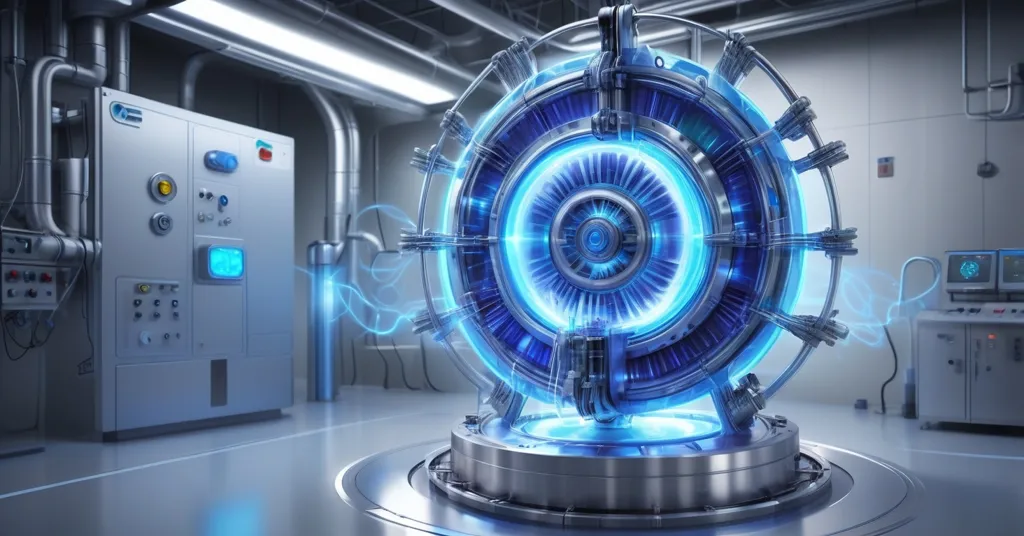
REBCO Super-Magnets: Fueling the Future of Compact Fusion Energy
REBCO super-magnets are revolutionizing fusion energy by enabling compact, powerful reactors with magnetic fields up to 20 Tesla. This breakthrough shrinks costs and sizes of tokamaks like SPARC, attracting €9.9 billion in investments. Discover how this tech drives exponential growth.
Fusion energy, once a distant dream of limitless clean power, is rapidly becoming a tangible reality thanks to a breakthrough in rare-earth barium copper oxide (REBCO) super-magnets. These cutting-edge materials are shrinking the size of fusion demo reactors while unleashing unprecedented power, paving the way for a sustainable energy revolution. With magnetic fields strong enough to confine super-hot plasma, REBCO is not just a technological marvel—it’s a catalyst for exponential growth in fusion energy innovations. Dive into how this innovation is transforming fusion, attracting billions in investment, and offering actionable lessons for business leaders and innovators eager to ride the wave of exponential technologies.
Fusion 101: Unlocking the Power of the Stars
At its core, fusion energy mimics the process that powers the sun, combining lightweight atoms like hydrogen to release massive amounts of energy without carbon emissions or long-term radioactive waste. The challenge lies in containing the ultra-hot plasma—think of it as a gas hotter than the sun’s core—using powerful magnetic fields within devices called tokamaks, which are donut-shaped reactors designed to trap and control this energy. Traditional materials struggled to generate strong enough fields, resulting in massive, costly designs. Enter REBCO, a high-temperature superconductor that operates with incredible efficiency, even at extremely cold temperatures close to absolute zero. By enabling stronger magnetic forces, REBCO allows reactors to be smaller, cheaper, and more feasible, bringing fusion closer to powering our grids. Learn more about the science behind these materials at this detailed resource on REBCO super-magnets.
The REBCO Revolution: A Technological Game-Changer
REBCO coated-conductor tapes are rewriting the rules of fusion technology. These super-magnets can generate magnetic fields up to 20 Tesla—a measure of magnetic strength that’s nearly double what older materials like Nb₃Sn could achieve. To put this in perspective, this invisible force is powerful enough to boost plasma pressure fourfold and increase power density tenfold in demo tokamaks. The result? Compact fusion reactors that pack a serious punch while slashing the physical footprint by roughly ten times compared to giants like the international ITER project. For deeper insights into their creation, check out this discussion on how REBCO super-magnets are transforming fusion energy.
Consider the SPARC tokamak, a collaboration between Commonwealth Fusion Systems (CFS) and MIT. Aiming for a 20 MW output—enough to power around 15,000 homes for a year—SPARC leverages 18-20 Tesla REBCO magnets to prove fusion can produce more energy than it consumes. Similarly, China’s BEST reactor targets 30 MW with 18 Tesla magnets, while Germany’s Proxima Fusion pushes boundaries with its Alpha stellarator, delivering 20 MW of steady-state power using 16 Tesla racetrack magnets. These compact designs align with Exponential Organization (ExO) principles of agility, shrinking design-build-test cycles from nine months to just six weeks thanks to REBCO’s modular coil approach. It’s rapid innovation in action, showing how technology can accelerate progress at an unprecedented pace.
Global Momentum: Billions Invested in Fusion’s Future
The promise of REBCO technology has ignited a global investment frenzy. By mid-2025, cumulative private funding for fusion energy reached an astonishing €9.9 billion, with 65% directed toward magnetic-confinement projects harnessing REBCO advancements. CFS leads the charge with $3.0 billion raised, followed by Helion Energy at $0.9 billion and the UK’s Tokamak Energy with €0.31 billion. Proxima Fusion, a German startup, secured €0.19 billion, marking the largest EU funding round and highlighting the worldwide appetite for fusion breakthroughs.
Cost projections add to the excitement. REBCO tape prices are expected to drop from $100 per kiloampere-meter to under $10 by the late 2020s due to scaled production, much like how solar panel costs plummeted over time. This affordability could transform fusion from an experimental endeavor into a competitive energy source, opening doors for smaller players and developing regions to join the race.
Strategic partnerships are equally crucial, bridging the gap to real-world impact. A standout example is CFS’s 200 MW Power Purchase Agreement (PPA) with Google, signed in 2025, tied to the future grid integration of the ARC reactor in Chesterfield County, Virginia, with delivery expected in the early 2030s. Michael Terrell, Head of Advanced Energy at Google, captured the significance of this collaboration in a strategic partnership announcement with CFS:
“By entering into this agreement with CFS, we hope to help prove out and scale a promising pathway toward commercial fusion power. We’re excited to make this longer-term bet on a technology with transformative potential.”
Bob Mumgaard, CEO and Co-founder of CFS, emphasized the broader vision:
“Fusion power is within our grasp thanks in part to forward-thinking partners like Google… We aim to demonstrate fusion’s ability to provide reliable, abundant, clean energy at the scale needed to unlock economic growth.”
Utilities are also stepping up, with Dominion Energy VA partnering with CFS on molten-salt loop integration for heat transfer, China’s State Grid Corp. collaborating with BEST on super-critical water studies, and Germany’s BDEW advising Proxima Fusion on helium-gas turbine concepts. These alliances underscore a unified push toward grid-ready fusion systems, aligning with ExO strategies of leveraging external networks for exponential impact.
Challenges on the Horizon: Balancing Promise with Reality
For all its potential, REBCO technology isn’t without hurdles. The material’s brittleness can complicate mass production, risking cracks or failures under the intense conditions of a reactor. Manufacturing inconsistencies further challenge scalability, while integrating compact fusion reactors with existing grid infrastructure—even with “plug-and-play” designs—demands advanced control systems to handle voltage mismatches and ensure stability. These aren’t just technical speed bumps; they’re reminders that exponential growth often comes with exponential complexity. Explore community perspectives on these issues in this discussion about REBCO compact fusion reactor challenges.
Yet, solutions are emerging. Research into more durable REBCO composites is gaining traction, and pilot projects are testing grid integration strategies to smooth the transition. Regulatory agility also helps—in the US, fusion projects fall under accelerator rules, cutting licensing times to under 24 months compared to the decades-long timelines for fission. Support from initiatives like the DOE Milestone Program, which allocated $15 million to SPARC research in 2025, fuels progress. Events like the 2025 CERN CCA Workshop will further drive discussions on cost reduction and standardization, ensuring these challenges don’t derail the fusion revolution.
Fusion Beyond Energy: Exponential Opportunities
The impact of REBCO-enabled fusion extends far beyond electricity generation. As a carbon-free, baseload power source, it aligns with global net-zero goals, offering a path to decarbonize industries from manufacturing to transportation. Consider the soaring energy demands of AI data centers—tech giants like Google, already invested in fusion, could use compact reactors to sustainably power their operations. Fusion could also drive desalination plants, addressing water scarcity, or support energy-intensive industrial processes, unlocking economic growth as Mumgaard described in what he calls “the largest market transition in history.”
For business leaders, this signals a landscape ripe for innovation. Entrepreneurs might explore adjacent technologies like advanced cooling systems for reactors, while consultants can guide clients through energy transitions. The ripple effects of fusion touch every sector, creating opportunities for those ready to think exponentially and act decisively.
Applying ExO Principles: Lessons from Fusion Innovation
The fusion race offers a masterclass in Exponential Organization (ExO) methodologies that any leader can apply. First, embrace rapid experimentation—much like CFS compresses test cycles to six weeks with REBCO’s modular designs, your organization can prototype bold ideas quickly to stay ahead of the curve. Second, leverage strategic partnerships, as seen with Google’s PPA or utility collaborations, to scale impact beyond internal capabilities. Third, adopt abundance thinking by focusing on technologies with 10x potential, whether in energy or your own field, to redefine what’s possible. Finally, build interfaces—fusion’s grid-ready systems mirror how businesses can design seamless integrations to connect with larger ecosystems. For academic insights into these advancements, refer to this collection of studies on REBCO technology in compact fusion reactors.
These principles aren’t just theoretical; they’re proven strategies for achieving transformative growth. By mirroring fusion innovators, you can position your organization to capitalize on disruptive shifts, turning challenges into opportunities for exponential success.
Critical Questions for the Future of Fusion
- How will the projected drop in REBCO tape costs to below $10 per kiloampere-meter by the late 2020s impact scalability and accessibility? This dramatic reduction could democratize fusion, making reactors affordable for smaller firms and emerging markets, thus speeding up global adoption and leveling the playing field.
- What technical risks linger in integrating compact fusion reactors with existing grids? Grid stability and voltage alignment remain concerns, requiring robust control systems and infrastructure upgrades to prevent disruptions—a hurdle as critical as the technology itself.
- How might regulatory frameworks evolve beyond current US accelerator rules post-2025? As fusion scales, international standards could emerge, streamlining safety protocols while addressing public concerns, much like aviation rules evolved with global travel.
- What role will global collaboration, as seen at the CERN CCA Workshop, play in standardizing REBCO technology? These platforms can foster shared innovations and protocols, reducing redundant efforts and ensuring equitable access across regions—an ExO community approach in action.
- Could heavy reliance on private funding create disparities in fusion tech access? There’s a real risk of well-funded areas dominating progress, but public-private partnerships and global initiatives could bridge gaps, ensuring fusion benefits aren’t hoarded by a few.
The dawn of commercial fusion energy, powered by REBCO super-magnets, is no longer a far-off vision but a near-term possibility. With costs poised to fall, partnerships solidifying, and global collaboration intensifying, the stage is set for a seismic shift in how we power our lives. For business professionals, consultants, and executives, now is the moment to engage with these developments. Dive into ExO methodologies to harness rapid experimentation and strategic alliances for 10x growth in your own endeavors. Reflect on these key takeaways as you forge ahead:
- REBCO magnets, with 20 Tesla fields, are enabling compact fusion reactors like SPARC and BEST to redefine energy production.
- Private investment of €9.9 billion by 2025 reflects massive confidence in fusion’s future.
- Partnerships with tech leaders like Google and utilities are vital for integrating fusion into grids.
- Projected cost drops in REBCO tapes could make fusion economically viable by the late 2020s.
- Global collaboration and regulatory flexibility are essential to scaling this technology equitably.
Take the leap—explore fusion’s potential and apply ExO frameworks to amplify your impact. The energy future is unfolding, and you have the power to shape it.

ExO Insight Newsletter
Join the newsletter to receive the latest updates in your inbox.