
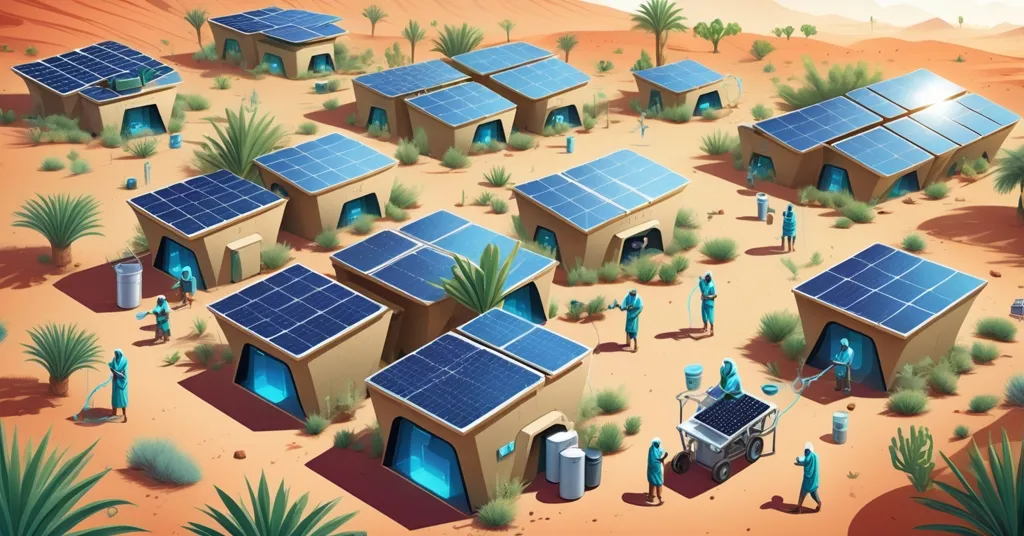
MOF-303 Modules Revolutionize Water Security with Community-Scale Harvesting
Discover how MOF-303 modules are transforming water security with community-scale atmospheric harvesting. Powered by solar energy, this breakthrough technology extracts clean water from even the driest air, offering a sustainable lifeline to water-stressed regions.
Water scarcity grips half a billion people every year, a crisis deepened by climate change and population pressures. In East Africa, women and children often trek three hours daily to fetch water—time that could fuel education or income. Yet, a transformative breakthrough is reshaping this narrative: community-scale atmospheric water harvesting using MOF-303 sorbent modules. Powered by off-grid solar energy and rooted in Exponential Organization (ExO) principles, this technology extracts clean water from the air, even in the driest regions, offering a bold path to exponential water security.
The Water Scarcity Crisis: A Global Challenge
Ranked among the top global risks by the World Economic Forum for nearly a decade, water scarcity disrupts lives across arid and water-stressed regions. Beyond the sheer lack of access, it perpetuates cycles of poverty, with millions spending hours daily on water collection instead of building futures. Traditional solutions like centralized infrastructure often fail remote communities due to high costs and logistical barriers. Enter a new era of innovation where technology meets abundance thinking to tackle this pressing issue head-on.
MOF-303 technology, a product of cutting-edge materials science, emerges as a game-changer. It not only addresses immediate needs but also aligns with Sustainable Development Goal 6 (SDG 6) for clean water and sanitation, paving the way for sustainable impact at scale. For a deeper understanding of the framework behind this innovation, explore the details on metal-organic frameworks. Let’s dive into how this solution works and why it’s poised to redefine water access globally.
MOF-303 Technology: Pulling Water from Thin Air
At the heart of this revolution lies MOF-303, a metal-organic framework (MOF) that acts like a super-absorbent sponge crafted from metal and organic compounds. It captures water molecules from the air, even in bone-dry conditions, through a process of adsorption and desorption—think of it as trapping moisture and then squeezing it out as liquid in quick, repeatable cycles. Developed with eco-friendly, water-based methods at Washington University, MOF-303 boasts a high production efficiency, keeping manufacturing costs between $20-30 per kilogram. Learn more about these advancements through research on green synthesis methods.
The performance is striking: MOF-303 modules deliver 3-5 liters of water per day per kilogram, even at just 20% relative humidity—a feat unmatched by many traditional systems. Powered entirely by solar energy, these off-grid units sidestep the need for costly infrastructure or fossil fuels. Rapid cycles ensure consistent output, making this sustainable water technology a lifeline for arid regions where every drop counts. For the latest data, check out recent performance metrics on this technology.
Real-World Impact: Pilot Programs Transforming Lives
The proof of MOF-303’s potential shines in pilot programs across diverse climates. In East Africa, specifically Tanzania, Kenya, and Uganda, 5-kilogram modules produce 15-25 liters daily, meeting World Health Organization (WHO) drinking water standards with over 95% system uptime. One family in rural Tanzania, previously spending hours fetching water from distant wells, now accesses clean water steps from their home. This shift has freed up time for children to attend school and parents to pursue small-scale farming, boosting both education and income. Insights into challenges in these regions can be found in studies on solar power limitations in arid East Africa.
In high-humidity coastal areas of Southeast Asia, such as Indonesia and the Philippines, units yield 8-12 liters daily, adapting to different environmental conditions. While outputs vary based on local climate—research shows coastal systems can reach up to 100 liters daily with optimized designs—these results highlight MOF-303’s versatility. Across a projected 1,000-community rollout, this technology could serve 15,000 people, producing 1.35 billion liters of water annually and saving 10.95 million hours spent on water collection.
The ripple effects are profound. Communities save $2,500 annually on healthcare costs due to fewer waterborne diseases, while 2,000 jobs are created through deployment and maintenance. Environmentally, MOF-303 systems cut 1,200 tons of CO₂ emissions each year compared to diesel alternatives and preserve 1.35 billion liters of groundwater, aligning directly with global sustainability goals. For community perspectives, see discussions on MOF-303’s impact.
Scaling with Exponential Organization Principles
The true power of MOF-303 lies not just in its technology but in its scalability through Exponential Organization (ExO) strategies. By leveraging Staff-on-Demand, local technicians and gig workers are trained to install and maintain units, slashing operational costs while fostering community ownership. Leveraged Assets come into play through shared solar infrastructure, avoiding the burden of heavy capital investments. Community & Crowd engagement ensures localized impact, with residents becoming active stakeholders in water security solutions. Discover more about these strategies at ExO principles in technology deployment.
Financial innovation further accelerates adoption. Deployment costs of $3,728 to $4,504 per unit drop to a lifecycle cost of just $0.276 per liter at a scale of 500 units. Models like Water-as-a-Service and revenue-sharing eliminate upfront costs for water-stressed communities, pricing water between $0.05 and $0.12 per liter for a return on investment of 1.7% to 4.1%. A $3.986 million investment for 1,000 communities, with 40% from development finance institutions and 25% from impact investors, showcases how blended finance can drive social good alongside financial returns.
As one expert notes:
This represents more than incremental improvement in water access—it embodies the emergence of exponential water security solutions.
This fusion of breakthrough materials science and exponential business models positions atmospheric water harvesting as a cornerstone for shifting from scarcity to abundance. For insights into sustainable solutions, explore solar-powered water security innovations.
Challenges and Future-Proofing Solutions
While the promise of MOF-303 sparkles brighter than a desert mirage, challenges remain. Solar dependency poses risks in regions with inconsistent weather, such as prolonged cloud cover, which could dampen output. Hybrid energy solutions or battery storage can bridge this gap, ensuring steady operation. Cultural resistance to new technology in some communities also looms as a hurdle—addressing this requires tailored engagement, emphasizing local benefits and involving trusted leaders to build acceptance. For broader discussions on addressing water scarcity, visit thoughts on tech solutions for water crises.
Maintenance in remote areas presents another concern, especially where technical expertise is scarce. Simplifying systems with user-friendly interfaces and offering remote support can help, as can training local hands to sustain operations. Research also points to dew point temperature as a key factor in water harvesting efficiency, suggesting that climate-specific designs are vital for maximizing output across varied regions.
Looking ahead, there’s room to push boundaries further. Consider these thought-provoking questions and potential paths forward for organizations aiming to amplify the impact of sustainable water technology:
- How can lifecycle costs be driven below $0.276 per liter to reach even more marginalized communities? Scaling production, optimizing energy use through algorithmic intelligence, and securing government subsidies could slash costs further, broadening access.
- What are the risks of solar power reliance in inconsistent weather, and how can they be mitigated? Beyond hybrid systems, integrating low-cost wind or micro-grid solutions could provide backup, ensuring reliability in challenging climates.
- How can AI-driven maintenance become accessible in areas with limited tech infrastructure? Developing plug-and-play diagnostic tools and partnering with NGOs for on-the-ground training can empower communities to manage systems independently.
- What partnerships or policies could speed up global adoption to meet SDG 6 targets early? Government incentives for off-grid water solutions, coupled with NGO-driven pilot expansions, could fast-track deployment on a massive scale.
- How can revenue-sharing models adapt to diverse cultural and economic contexts? Customizing pricing and engagement based on local values—such as bartering systems in some regions—ensures models resonate with unique community needs.
A balanced view must also acknowledge potential skepticism. Could an over-reliance on tech divert focus from systemic issues like poor governance or failing infrastructure? While MOF-303 offers a powerful tool, it’s not a standalone fix—pairing it with policy reform and investment in broader water systems will ensure lasting change.
Broader Horizons: Beyond Water Security
The implications of MOF-303 stretch far beyond quenching thirst. The same materials science driving this innovation could unlock solutions in food security—think moisture-retaining systems for agriculture—or energy storage, with MOFs potentially enhancing battery efficiency. This signals a wider canvas for abundance thinking, where exponential technologies tackle interconnected global challenges. Business leaders can draw inspiration from this convergence, exploring how similar approaches might revolutionize their sectors, from healthcare to logistics.
The efficiency of solar-powered systems, with research showing 1.871 to 3.248 kilograms of water harvested per kilowatt-hour across climates, underscores the potential for cost-effective, scalable impact. For industries eyeing sustainability, this is a blueprint for harnessing exponential growth strategies to drive 10x outcomes without breaking the bank.
Building a Future of Abundance: Your Next Steps
For business leaders, consultants, and C-suite executives, the MOF-303 revolution sounds a clarion call. This isn’t just about water—it’s about redefining how we solve humanity’s toughest problems through innovation and exponential thinking. Dive into ExO methodologies like Leveraged Assets and Staff-on-Demand to transform your approach to sustainability. Partner with communities, impact investors, or tech pioneers to pilot solutions that align with a vision of abundance over scarcity.
Take proactive steps now. Explore how your organization can integrate cutting-edge technologies or forge alliances that prioritize transformative impact. The path to exponential water security and beyond is open—step forward with bold strategies that turn global challenges into opportunities for 10x growth.
- MOF-303 technology delivers 3-5 liters of water per day per kilogram, even at 20% humidity, at a lifecycle cost as low as $0.276 per liter at scale.
- ExO principles like Leveraged Assets enable rapid, cost-effective deployment, sidestepping heavy infrastructure costs.
- Pilot programs in East Africa and Southeast Asia prove real-world success, meeting WHO standards and cutting healthcare costs from waterborne diseases.
- Revenue-sharing models remove upfront costs, creating sustainable value for communities and investors.
- A 1,000-community rollout could serve 15,000 people, save millions of hours, and preserve groundwater, aligning with SDG 6 goals.

ExO Insight Newsletter
Join the newsletter to receive the latest updates in your inbox.