
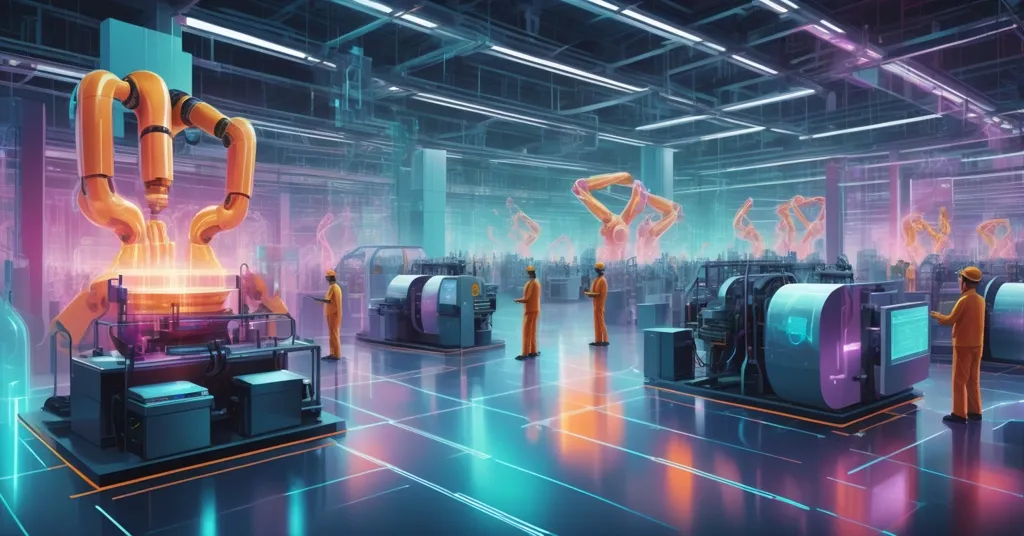
Industrial Metaverse 2.0: Transforming Smart Factories with AI and Digital Twins
Industrial Metaverse 2.0 is revolutionizing smart factories with AI copilots and digital twins, promising real-time optimization and predictive maintenance. With the market set to soar to $600.6 billion by 2032, this tech offers exponential growth, slashing downtime and boosting productivity.
The factory floor of tomorrow is no longer confined to physical machines and human oversight. Picture a dynamic digital realm where every asset, process, and decision is mirrored in real-time, predicting breakdowns before they happen and optimizing performance with precision. This is the promise of Industrial Metaverse 2.0, a powerful convergence of extended reality (XR), physics-based simulation, and AI copilots that’s redefining smart factories and driving exponential growth in manufacturing.
With the industrial metaverse market projected to surge from $48.2 billion in 2025 to an astonishing $600.6 billion by 2032 at a compound annual growth rate of 20.5%, the potential for transformation is undeniable. Fueled by digital twins—virtual replicas of physical systems that update instantly with live data—and innovative tools like Simulation-as-a-Service, this technology is slashing downtime, boosting productivity, and paving the way for sustainable operations. Evidence from the World Economic Forum’s Global Lighthouse Network, which encompasses 189 cutting-edge facilities, reveals staggering results: 53% productivity gains, 75% reductions in downtime, and a 4-5 times return on investment within five years. For business leaders and innovators, this isn’t just a trend—it’s a blueprint for the future.
Unpacking Industrial Metaverse 2.0: A New Manufacturing Paradigm
At its core, Industrial Metaverse 2.0 blends advanced technologies to create immersive, data-driven ecosystems for manufacturing. Digital twins act as virtual shadows of factory machines or entire systems, allowing manufacturers to test scenarios and predict issues before they disrupt production. Extended reality, which includes augmented reality (AR) for overlaying digital information on the real world, virtual reality (VR) for fully immersive environments, and mixed reality (MR) for blending both, transforms how tasks and training are approached. Add AI copilots—intelligent assistants that streamline workflows through natural language interaction—and you have a system that doesn’t just enhance operations but reimagines them as exponential rather than linear.
One compelling perspective captures this shift:
Industrial Metaverse 2.0 represents more than technological evolution—it embodies a fundamental reimagining of manufacturing as exponential rather than linear systems.
The urgency to adopt these tools is tied to broader trends in Industry 4.0, where global supply chain disruptions and sustainability mandates demand smarter, more resilient operations. As manufacturers face increasing complexity and labor shortages, the need for predictive maintenance with AI and real-time data integration becomes not just advantageous but essential. For deeper insights, explore relevant case studies on Industrial Metaverse implementation.
The Power of Digital Twins: Predicting and Optimizing Performance
Digital twins are the beating heart of this transformation. Unlike static models, these virtual replicas sync with live data to mirror and predict the behavior of physical assets. They enable manufacturers to simulate production runs, anticipate equipment failures, and make autonomous decisions to prevent costly interruptions. Imagine a factory manager spotting a potential machine breakdown through a digital twin days in advance—downtime becomes a problem of the past. Curious about their impact? Check out discussions on how digital twins are transforming manufacturing.
Siemens, a leader in industrial automation, exemplifies this with its Industrial Copilot, built on Microsoft Azure OpenAI Service. This AI tool reduces development time by 60%, creating panel visualizations in just 30 seconds and generating code that needs only minimal adaptation. With 120,000 engineers already leveraging Siemens’ software, the scale of adoption is striking. Beyond efficiency, it addresses pressing challenges like labor shortages by automating repetitive tasks, freeing human talent for innovation. Learn more about Siemens Industrial Copilot’s efficiency gains.
XR: Transforming Training and Operations
Extended reality is another game-changer, with 81% of manufacturing CEOs reporting measurable benefits from its adoption. Companies like Airbus use Microsoft HoloLens 2 to guide complex assembly tasks with AR overlays, while McLaren Automotive employs VR tools like Vector Suite for rapid design iterations in 3D environments. The impact on workforce readiness is equally profound—XR cuts onboarding time by 60%, offering interactive simulations that boost skill retention and prepare employees for the demands of smart factories.
Think about the last time a critical machine went down due to operator error. XR-based training could turn such setbacks into learning opportunities, equipping teams to handle high-stakes scenarios without real-world risks. It’s not just about efficiency—it’s about building a future-ready workforce.
Real-World Success Stories: Lessons from Lighthouse Factories
The proof of Industrial Metaverse 2.0 lies in its real-world impact. The World Economic Forum’s Global Lighthouse Network showcases facilities that have embraced digital transformation with remarkable results. Danone’s Opole facility in Poland slashed manufacturing costs by 19% and greenhouse gas emissions by 50% between 2019 and 2021. Unilever’s Tinsukia site in India uses AI-powered vision systems for real-time anomaly detection across over 50 supply chain initiatives. Schneider Electric’s Lexington Smart Factory leverages IoT and predictive analytics for energy efficiency, while Continental reduced 3D printed part costs by 83% and lead times by 75% through additive manufacturing innovations. Agilent, meanwhile, quadrupled inspection capacity with AI-driven quality control systems. Dive into detailed Global Lighthouse Network case studies for more on these achievements.
These aren’t isolated wins. Lighthouse factories consistently report 30-50% reductions in scope 1 and 2 emissions, with early progress on scope 3 as well. They demonstrate that profitability and sustainability can coexist, offering a roadmap for others to follow.
Why This Matters Now: The Urgency of Adoption
The projected growth of the industrial metaverse market to $600.6 billion by 2032 isn’t happening in a vacuum. Drivers like widespread IoT adoption, regulatory pressures for sustainability, and the need to address skilled labor shortages are accelerating this shift. Take thyssenkrupp, for instance, which uses Siemens Industrial Copilot for battery quality assurance in electric vehicle production—a critical step toward sustainable energy transitions. With plans for a global rollout in 2025, their approach highlights how exponential technologies solve immediate pain points while building long-term resilience. For a deeper look at market trends, review the industrial metaverse market growth projections.
A leader at thyssenkrupp captured this practical benefit:
Siemens Industrial Copilot will prospectively ease our workload and address the pressing challenges of labor shortages and increasing complexity in battery testing.
For manufacturers, the message is clear: adapt now or risk falling behind in a hyper-competitive landscape.
Challenges of Integration: Navigating the Roadblocks
Despite the promise, integrating these technologies into legacy systems presents significant hurdles. High upfront costs can deter smaller firms, while compatibility issues with older equipment create technical barriers. Cultural resistance within organizations often compounds the problem—workers may hesitate to trust AI-driven decisions over human judgment. Then there’s the looming concern of cybersecurity; real-time digital threads and IoT integration open vulnerabilities to data breaches and system disruptions.
Yet, these challenges aren’t insurmountable. Start with modular, cloud-based solutions like Simulation-as-a-Service to minimize initial investment. Pilot digital twins in high-impact areas like predictive maintenance to demonstrate quick wins. Address workforce hesitancy through upskilling programs—XR training can build digital fluency while fostering buy-in. On the security front, robust encryption and zero-trust models can safeguard connected ecosystems. The key is a phased approach, rooted in Exponential Organization (ExO) principles like scalability and adaptability, to turn obstacles into stepping stones.
A Balanced Perspective: Risks of Over-Reliance
While the benefits of Industrial Metaverse 2.0 are compelling, there’s a flip side to consider. Over-reliance on AI and digital tools could erode human oversight, potentially leading to unchecked errors if systems fail. A glitch in a digital twin’s predictive model, for instance, might trigger unnecessary shutdowns, costing time and resources. Moreover, the focus on automation risks widening the digital divide, leaving smaller manufacturers or less tech-savvy workers struggling to keep pace. For community perspectives, explore experiences with AI copilots in smart factories.
Balancing technology with human judgment is crucial. Regular audits of AI systems, paired with continuous training to ensure workers can intervene when needed, can mitigate these risks. For smaller firms, leveraging open-source tools or government grants for digital transformation can level the playing field. The goal isn’t to replace human expertise but to amplify it—a point worth emphasizing:
The future belongs to manufacturers who recognize that Industrial Metaverse 2.0 is not about replacing human expertise but rather amplifying human capabilities through exponential technologies.
Applying ExO Principles: Building Sustainable Competitive Advantage
Exponential Organization strategies provide a framework to harness these innovations effectively. Consider the concept of a Massive Transformative Purpose (MTP)—a guiding vision like “zero-waste manufacturing” that digital twins can enable by optimizing resource use. Interfaces, another ExO principle, come into play with platforms like Siemens Industrial Copilot, which bridge human input and automated processes seamlessly. By focusing on autonomy and real-time data, manufacturers can scale operations beyond traditional limits, achieving 10x growth rather than incremental gains. Research further into AI copilots’ benefits and challenges in smart factories.
Think about how an MTP could rally your team around a shared goal, with digital tools as the engine to get there. This mindset shift, paired with actionable tech, is what separates leaders from laggards in today’s manufacturing landscape.
Future Implications: Beyond Manufacturing
The ripple effects of Industrial Metaverse 2.0 extend far beyond factory walls. The principles of real-time data and digital twins could revolutionize logistics by optimizing supply chains, healthcare by simulating patient care scenarios, or retail by enhancing inventory management. Workforce dynamics will evolve too—remote operations powered by XR could redefine where and how work happens, demanding hybrid skill sets that blend technical and creative expertise.
The projected market growth also signals a shift in training needs. As digital literacy becomes non-negotiable, companies must invest in continuous learning to stay agile. The question is, how will your organization prepare for these broader disruptions?
Critical Questions to Reflect On
- How can smaller manufacturing firms with limited budgets adopt Industrial Metaverse 2.0 technologies to stay competitive? Begin with cost-effective, cloud-based tools like Simulation-as-a-Service, targeting high-impact areas such as predictive maintenance to achieve quick returns on investment.
- What are the primary barriers to integrating XR and AI copilots into legacy systems, and how can they be overcome? Challenges include technical compatibility and workforce resistance. Overcome them by starting with small-scale pilots and investing in training to build digital confidence across teams.
- How does the scalability of digital transformation in Lighthouse factories translate to industries beyond manufacturing? The use of real-time data and digital twins can enhance decision-making in sectors like logistics or healthcare, reducing inefficiencies and improving outcomes just as in factories.
- What cybersecurity risks come with real-time digital threads and IoT integration in smart factories, and how can they be mitigated? Risks include data breaches and system vulnerabilities. Mitigate them with strong encryption, regular security audits, and zero-trust frameworks to protect connected systems.
- How will the projected growth of the industrial metaverse market to $600.6 billion by 2032 impact workforce skills and training? It will necessitate a pivot to digital literacy and hybrid skills, pushing organizations to prioritize ongoing education and XR-based learning for adaptability.

ExO Insight Newsletter
Join the newsletter to receive the latest updates in your inbox.