
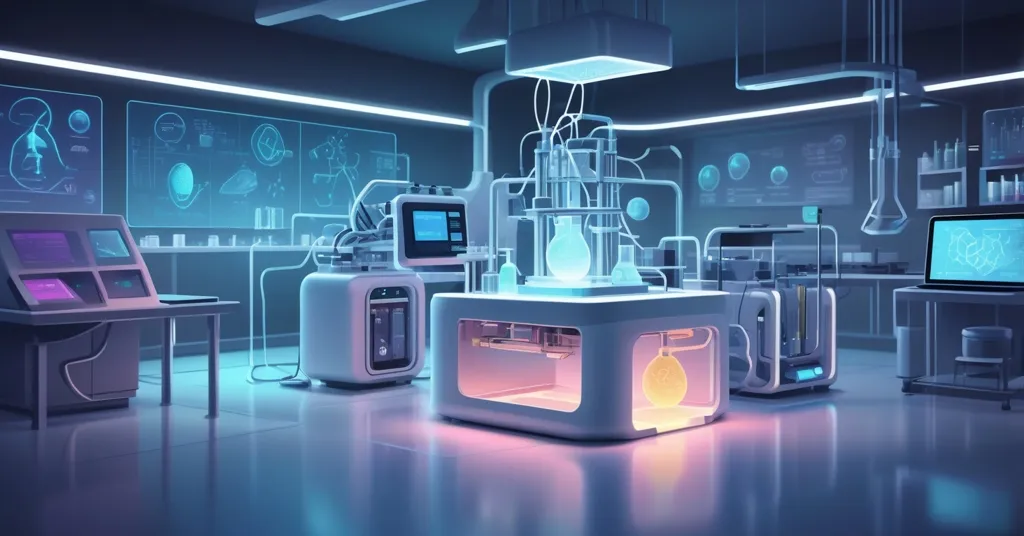
Enzymes-as-a-Service for Exponential Biotech Growth
Cell-free biomanufacturing is revolutionizing biotech with on-demand enzyme and protein production, bypassing the limitations of living cells. This cutting-edge approach offers speed, scalability, and flexibility, promising exponential growth for industries like pharmaceuticals and fragrances.
Picture a future where critical enzymes and proteins are produced at the flick of a switch, anywhere on the globe, without the cumbersome limitations of living cells. That’s the promise of cell-free biomanufacturing—a cutting-edge approach that’s reshaping biotechnology with remarkable speed, flexibility, and scalability. This technology isn’t just a lab curiosity; it’s a game-changer for industries ranging from pharmaceuticals to fragrance production, offering a pathway to exponential growth in a world hungry for innovation.
Let’s dive into how this transformative technology works, why it’s gaining traction among business leaders and innovators, and what it means for organizations looking to stay ahead of the curve. From economic advantages to real-world applications, we’ll explore the potential of cell-free systems to redefine production and unlock new opportunities.
What is Cell-Free Biomanufacturing?
At its core, cell-free biomanufacturing is a method of producing enzymes and proteins without relying on living cells. Think of it as a 3D printer for biology, churning out custom materials on demand. By using technologies like transcription-translation (TX-TL) platforms—systems that mimic cellular protein production outside of cells—and the PURE system, a highly controlled synthetic setup, this approach bypasses the slow, complex processes of traditional cell-based methods. For a deeper understanding, you can explore the basics of cell-free systems.
The advantages are clear. Without the constraints of maintaining living organisms, production can achieve protein yields as high as 8 mg/mL in ongoing processes and 4 mg/mL in single batches—enough to support thousands of diagnostic tests or specialty applications from a small setup. This isn’t just faster; it’s a fundamental shift toward agility in biotechnology innovation.
The Economic Case for Adoption
Cell-free biomanufacturing makes a striking economic argument, especially for high-value, low-volume applications like rare enzymes or diagnostic biosensors. Optimized systems reach break-even points at just 120 kg annually, boasting gross margins over 61%. That’s a compelling case for niche markets where traditional setups, often costing millions to establish, struggle to compete.
Getting started is more accessible than you might think. A pilot facility requires an initial investment of around $276,000—a fraction of the cost for cellular manufacturing plants. While operational expenses, largely driven by reagents, make up 60-70% of costs, innovations are slashing these figures. Doubling protein output from 2 to 4 mg/mL, for example, cuts unit costs by more than 40%. This trajectory signals that scalability isn’t a distant dream but a near-term reality for savvy adopters looking to embrace concepts like Enzymes-as-a-Service in biotech.
Technological Breakthroughs Driving Progress
The magic behind cell-free systems lies in cutting-edge advancements that amplify efficiency. Microfluidics integration, for instance, delivers a staggering 87-fold increase in protein production compared to older formats by continuously supplying nutrients. It’s like upgrading from a manual assembly line to a fully automated factory overnight.
Then there’s lyophilization—a freeze-drying process that keeps materials stable without refrigeration. These systems retain activity for months at room temperature, with successful tests even in extreme conditions like aboard the International Space Station via the BioBits platform. This opens the door to global distribution without the burden of cold chain logistics, a critical edge for reaching remote or underserved markets curious about real-world uses of cell-free technology.
Real-World Applications: From Fragrances to Pharmaceuticals
The versatility of cell-free biomanufacturing is turning heads across industries. Companies like eXoZymes are crafting bespoke fragrances with modular systems, proving that even luxury markets can benefit from biotech innovation. On a more critical front, field-deployed diagnostics and military applications showcase the technology’s ability to operate under pressure, delivering results where traditional methods falter.
In pharmaceuticals, the stakes are even higher. Global disruptions like the COVID-19 pandemic exposed vulnerabilities in supply chains, and cell-free systems offer a solution through decentralized production. Ginkgo Bioworks, a frontrunner in this space, secured a $29 million ARPA-H WHEAT contract to stabilize pharmaceutical supply chains by producing active ingredients, biologics, and small molecules using advanced protein modifications. As Jesse Dill, Senior Director of Business Development at Ginkgo Bioworks, put it:
We are thrilled for the opportunity to work on this exciting project with ARPA-H and our teammates to allow Americans to reap the benefits when we bring together innovations in farm and pharma.
Similarly, Tierra Biosciences is leveraging AI-driven platforms for high-throughput protein synthesis, backed by $11.4 million in Series A funding. Their approach accelerates discovery cycles, tackling inefficiencies head-on. Michael Nemzek, CEO of Tierra Biosciences, captured the shift:
Traditional protein engineering using living cells is slow, inefficient, and data poor. Tierra’s cell-free protein production platform will change the game, powering our customers’ discovery efforts with rapid access to large numbers of discrete custom proteins.
Other leaders echo this optimism. Corinna Chen, Partner at Material Impact, noted:
Tierra's platform propels innovation in the bioeconomy by eliminating bottlenecks in protein discovery and manufacturing.
And Ronald T. Piervincenzi, CEO of USP, emphasized the broader impact:
Advanced manufacturing technologies and biomanufacturing are critical to bolstering supply chain resilience.
From Sutro Biopharma’s cGMP facility producing antibody-drug conjugates to academic institutions like Caltech and Northwestern University licensing foundational technologies, the momentum behind cell-free systems is undeniable. It’s paving the way for a future of distributed manufacturing in biotechnology, supported by Ginkgo Bioworks’ advancements in cell-free technology.
Challenges to Overcome
Despite the promise, hurdles remain on the path to widespread adoption. Launching a 6-month pilot program, for instance, demands an investment of roughly $390,000, with equipment accounting for 70% of the upfront cost. That’s a significant barrier for smaller players, though strategic partnerships can ease the burden.
Regulatory compliance poses another challenge, particularly in pharmaceuticals. Ensuring consistent quality and safety across decentralized production sites requires navigating complex standards and potential delays in scaling. Moreover, while cell-free systems hint at sustainability benefits—potentially reducing energy use compared to cell-based methods—the environmental impact of reagent production and waste management remains underexplored. Lifecycle assessments are needed to confirm net gains, a critical consideration for industries under pressure to go green, especially when evaluating challenges in pharmaceutical supply chains.
A balanced view also acknowledges that high-volume production still favors traditional methods in cost competitiveness. Cell-free systems excel in niche markets, but bridging the gap to broader applications will require continued innovation in yield optimization and reagent recycling.
Aligning with Exponential Growth Principles
Cell-free biomanufacturing embodies the core tenets of exponential organizations, as outlined in “Exponential Organizations 2.0.” It leverages abundance thinking by decentralizing production, tapping into global markets without reliance on centralized infrastructure. The scalability of platforms like those from Tierra Biosciences, enhanced by AI-driven optimization, mirrors the use of algorithms to drive 10x growth. Even the collaborative models seen in Ginkgo Bioworks’ multi-state consortium reflect the power of community and interfaces in accelerating innovation.
This isn’t just technology for technology’s sake—it’s a massive transformative purpose in action. By addressing supply chain resilience and enabling rapid response to global health needs, cell-free systems align with the vision of creating impact at scale, a principle that resonates with changemakers and C-suite executives alike.
The Path Forward: Questions to Ponder
As we navigate this transformative landscape, several key questions arise that can guide strategic thinking and spark discussion. Here are some critical considerations, along with brief perspectives to fuel your exploration:
- How can cell-free biomanufacturing further reduce operational costs to compete with traditional methods for high-volume production?Advancements in reagent recycling and AI-driven process optimization, as demonstrated by Tierra Biosciences, could close the cost gap, making cell-free systems viable for larger-scale applications over time.
- What are the long-term regulatory hurdles for scaling cell-free systems in pharmaceutical applications, and how can industry collaboration address them?Consistency in quality across decentralized sites is a sticking point. Collaborative frameworks, like Ginkgo Bioworks’ consortium, could standardize protocols and advocate for adaptive regulations to speed up approvals.
- How might advancements in automation and AI enhance the efficiency and scalability of cell-free platforms?AI can streamline design-build-test-learn cycles, while automation reduces human error. Together, they could transform pilot facilities into global networks, scaling production with precision and speed.
- What are the environmental implications of widespread adoption of cell-free systems, especially regarding energy use and waste?These systems may cut energy demands by avoiding cell culture maintenance, but reagent production could create waste. Detailed studies are essential to quantify sustainability benefits and address potential downsides.
- How can cell-free biomanufacturing integrate into existing industrial ecosystems without disrupting current workflows?Modular platforms and partnerships, as seen with eXoZymes’ fragrance focus, allow gradual integration. Tailored pilot programs can ensure compatibility with established processes, minimizing friction.
Looking Ahead: The Future of Biotechnology
The horizon for cell-free biomanufacturing is brimming with potential. Emerging trends point to integrations with other exponential technologies—think blockchain for supply chain transparency or VR/AR for process simulation. These synergies could further enhance traceability and efficiency, positioning cell-free systems as a cornerstone of biotech scalability.
More immediately, the focus on national health security, as highlighted by initiatives like ARPA-H’s WHEAT program, underscores a geopolitical angle. Reshoring critical medicine production through decentralized systems isn’t just a business strategy; it’s a matter of resilience in an unpredictable global landscape.
The path forward is clear: cell-free biomanufacturing, often dubbed Enzymes-as-a-Service, is a vital technology for the next decade. Its ability to decentralize production, strengthen supply chains, and unlock diverse applications aligns seamlessly with the pursuit of exponential growth. So, take the leap. Explore how these strategies can revolutionize your organization’s approach to production with these key takeaways to guide you:
- Cell-free biomanufacturing offers unmatched flexibility, producing proteins at scale for high-value applications like diagnostics and specialty chemicals.
- Its economic viability shines with low break-even points at 120 kg/year and gross margins over 61%, ideal for niche markets.
- Cutting-edge technologies like microfluidics and freeze-drying boost efficiency and enable global distribution without refrigeration.
- Industry pioneers such as Ginkgo Bioworks and Tierra Biosciences lead with AI integration and decentralized production models.
- Strategic investments in pilot programs and partnerships can position your organization at the forefront of this biotech revolution.

ExO Insight Newsletter
Join the newsletter to receive the latest updates in your inbox.