
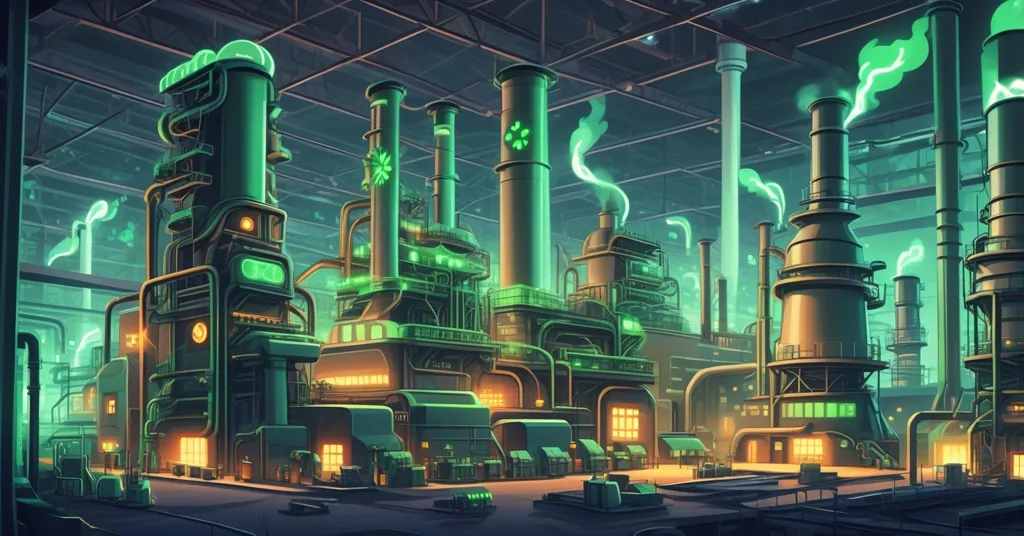
AI-Driven Green Steel Flywheel with EAF Technology
Steel, the backbone of infrastructure, is transforming with AI-optimized electric arc furnaces (EAFs). This green-steel revolution slashes carbon emissions and boosts efficiency, driven by innovation and regulatory pressures.
Steel, the foundation of modern infrastructure, is undergoing a profound transformation. As global demands for sustainability intensify, the industry faces a pivotal moment where innovation isn't just an option—it's a necessity. Enter AI-optimized electric arc furnaces (EAFs), a breakthrough technology that promises not only to slash carbon emissions but also to redefine efficiency and competitive advantage in a market increasingly shaped by environmental constraints. This convergence of artificial intelligence and sustainable steelmaking is creating a powerful cycle of progress—a green-steel flywheel—where each advancement builds on the last, driving exponential growth for those bold enough to lead the charge.
The Tech Behind Green Steel: AI and EAFs in Action
Traditional steel production, heavily reliant on coal-driven blast furnaces, has long been a major contributor to global carbon emissions. Electric arc furnaces offer a cleaner alternative by recycling scrap metal using electricity, drastically cutting emissions when powered by renewable sources. What elevates this technology to new heights is the integration of artificial intelligence. Smart systems, which learn from data to optimize performance over time, are fine-tuning every aspect of EAF operations. For instance, JP Steel Plantech’s AI-driven electrode control systems reduce energy use by an impressive 8% per tonne of steel produced. This isn't a small tweak—it's a significant leap that lowers operational costs while shrinking environmental impact.
Research from Slovenia’s Institute of Metals and Technology underscores these gains. Their studies show a 5% boost in productivity, a drop in energy consumption from 450 to 440 kilowatt-hours per tonne (a 3.5% improvement), and an 8.7% reduction in productivity costs over just one year with AI optimization. Even the time to complete a production cycle—known as tap-to-tap time—has been trimmed from 90 to 85 minutes, a nearly 6% improvement, while daily output increased by 50 tonnes of liquid steel. These numbers reveal an industry not merely adapting but racing toward a future where efficiency and sustainability go hand in hand.
Beyond energy savings, AI is revolutionizing raw material use. Platforms like ScrapChef, deployed by ArcelorMittal Hamburg, autonomously determine the optimal mix of scrap metal, delivering cost savings of 1-5% while ensuring compliance with tough environmental standards. Think of it as a master chef crafting the perfect recipe—only this one cuts costs and carbon footprints simultaneously. With such tangible benefits, it’s clear that AI-powered EAFs offer substantial sustainability benefits; they’re more than a trend; they’re the backbone of sustainable steelmaking.
Regulatory Catalysts: The Push for Decarbonization
The drive toward green steel isn’t happening in a vacuum. Regulatory pressures are tightening the screws on carbon-intensive industries, with the EU Carbon Border Adjustment Mechanism (CBAM) leading the charge. Starting in 2026, this policy will require importers to pay fees based on the carbon emissions embedded in their steel, effectively penalizing high-pollution production methods. For steelmakers, this is a wake-up call: adapt or face steep tariffs that could erode market access in Europe. Projections suggest CBAM could significantly impact global steel trade, potentially slashing EU steel imports by up to 30% by 2034 under high carbon price scenarios, with exporters from countries like India facing costs of $210-$243 per ton. This isn’t just a regulation—it’s a catalyst fueling the green-steel flywheel by pushing companies to embrace AI and EAFs faster.
Real-world commitments highlight the urgency. Algoma Steel in Canada is investing $1.2 billion to shift to EAFs, targeting a 70% reduction in annual carbon emissions by 2027—equivalent to removing 900,000 passenger vehicles from the roads or cutting 3 million tonnes of CO2 yearly. Hailed as Canada’s largest decarbonization project, this move aligns with national net-zero goals by 2050. When paired with renewable energy, technologies like hydrogen-based direct reduction and EAFs can achieve up to 95% emission reductions compared to traditional methods, positioning early adopters as frontrunners in the green steel economy.
Innovations Amplifying Impact: Beyond the Furnace
The transformation doesn’t stop at furnaces. Supporting technologies are enhancing the efficiency and stability of EAF operations. Flywheel energy storage systems from companies like Temporal Power can store up to 50 kilowatt-hours of energy, responding in milliseconds to smooth out power spikes and ensure uninterrupted production even on unstable grids. Meanwhile, Siemens Industrial Copilot uses generative AI to speed up automation processes by 60%, crafting control code for furnaces through simple conversational inputs. These advancements feed into the green-steel flywheel, where each efficiency gain sparks further investment and innovation, creating a self-reinforcing loop of progress.
The market reflects this momentum, with projections estimating the EAF sector will grow from $868.6 million in 2025 to $1.89 billion by 2032, at an 11.8% annual growth rate. This surge signals a broader shift toward sustainable steelmaking solutions and innovations as both a business imperative and a competitive edge. But what does this mean for industry leaders? It’s a call to harness these exponential technologies to not just meet demands but to redefine what’s possible in heavy industry.
Challenges to Adoption: A Balanced Perspective
While the promise of AI-optimized EAFs is undeniable, the path forward isn’t without hurdles. Regional disparities highlight uneven adoption rates. For instance, Japan’s EAF steel production dropped 4.2% to 22.83 million tons in 2023, constrained by labor shortages and fluctuating demand in sectors like construction. Legacy mills in developing regions may struggle to access cutting-edge technologies without tailored strategies or policy support. This raises a critical question: how can the benefits of green steel be scaled equitably across diverse markets?
Moreover, over-reliance on AI for autonomous decision-making carries risks. System failures could halt production, and biased data might lead to inefficient outputs, underscoring the need for robust safeguards and human oversight. Balancing tech-driven efficiency with workforce impacts is another concern. As automation rises, what happens to communities reliant on traditional steelmaking jobs? Without retraining programs or transition plans, the social cost could be steep. These challenges in AI optimization for green steel remind us that while AI is a powerhouse, it’s not a magic wand—implementation demands strategy and foresight.
Long-term trade dynamics add another layer of complexity. While CBAM’s immediate effects are significant, its full impact on global steel trade may unfold over decades, with revenue projections exceeding $4.1 billion annually by 2034. This suggests the green-steel flywheel might build momentum more gradually in some regions, particularly for countries lagging in decarbonization technologies. Navigating these shifts will require not just innovation but also collaboration across industries and governments, as discussed in various analyses of CBAM’s trade implications.
Exponential Organization Principles in Action
The rise of AI-optimized EAFs aligns seamlessly with the principles of Exponential Organizations (ExOs) as outlined in Exponential Organizations 2.0. By leveraging models like Staff-on-Demand, steelmakers can access specialized talent for rapid implementation of AI systems without the overhead of permanent hires. Similarly, the use of Algorithms—think ScrapChef’s raw material optimization or Siemens’ generative AI—drives 10x improvements in efficiency and decarbonization impact. Interfaces, such as user-friendly AI platforms, further streamline adoption by bridging complex tech with practical operations.
For business leaders and changemakers, applying these ExO frameworks offers a roadmap to transformative growth. Start by identifying your organization’s Massive Transformative Purpose (MTP)—perhaps becoming a leader in sustainable industrial practices—and align AI and EAF initiatives to that vision. Use Community & Crowd strategies to tap into global expertise and innovation, accelerating your journey toward green steel. This isn’t just about adopting technology; it’s about building a culture of exponential thinking where sustainability and profit amplify each other.
Thought-Provoking Questions for the Future
- How can AI-optimized EAF technologies be scaled globally to ensure equitable access for smaller or legacy steel mills in developing regions? Government incentives, subsidies, and technology-sharing partnerships could lower barriers, enabling under-resourced mills to adopt sustainable practices without prohibitive costs.
- What risks come with relying on AI for autonomous decision-making in steel production, especially regarding system failures or data biases? Unexpected downtimes or flawed outputs from biased data could disrupt operations, highlighting the need for fail-safes and diverse datasets to keep systems reliable.
- How might EU CBAM regulations reshape global steel trade, particularly for countries with slower decarbonization progress? These nations risk losing market access and facing higher costs, potentially shifting trade toward low-carbon producers and widening economic gaps unless support mechanisms are in place.
- What role can government policies play in speeding up adoption of flywheel energy storage and AI systems in steelmaking? Tax breaks, grants, and fast-tracked regulations for clean tech, as seen in Canada’s climate initiatives, could drive investment and broader industry transformation.
- Are there ethical dilemmas in prioritizing AI efficiency over human labor in steelmaking, especially in job-dependent regions? Automation could displace workers, necessitating retraining and social programs to balance technological gains with community well-being.
Voices of Transformation
As we navigate this seismic shift, powerful observations from industry thought leaders capture the stakes and potential:
The convergence of artificial intelligence and electric arc furnace technology has reached a transformative inflection point in 2025, where reinforcement-learning controllers are delivering validated 8% energy reductions per tonne while enabling precise scrap blend optimization.
The green-steel flywheel represents more than technological advancement—it embodies the emergence of truly exponential steelmaking where biological learning principles, artificial intelligence, and sustainable operations converge to create competitive advantages.
Organizations that master AI-optimized EAF technology will capture disproportionate value in the emerging green steel economy, while those that delay adoption risk obsolescence in an increasingly carbon-constrained industrial landscape.

ExO Insight Newsletter
Join the newsletter to receive the latest updates in your inbox.